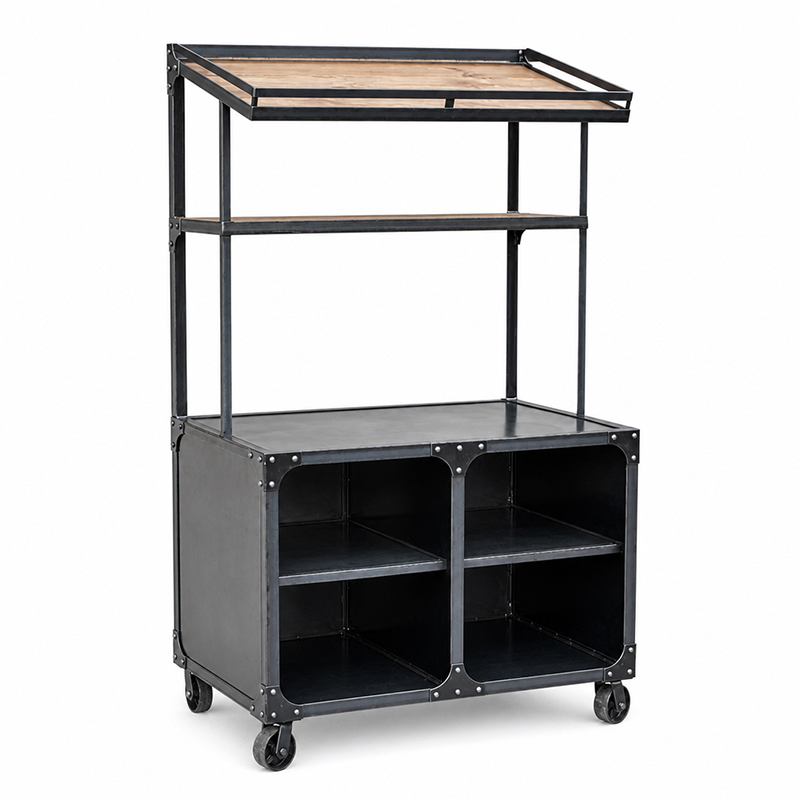


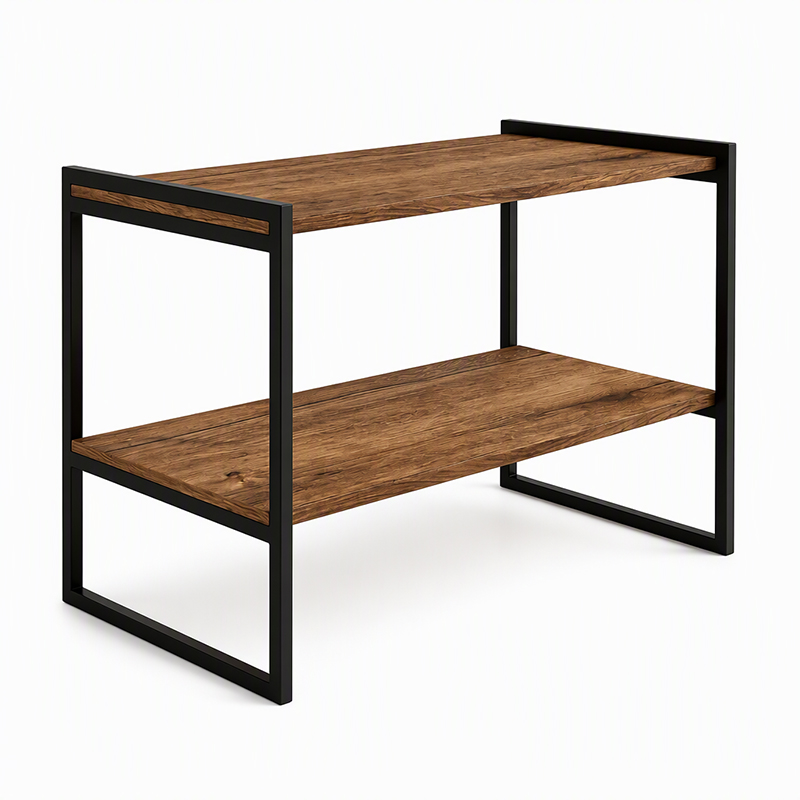
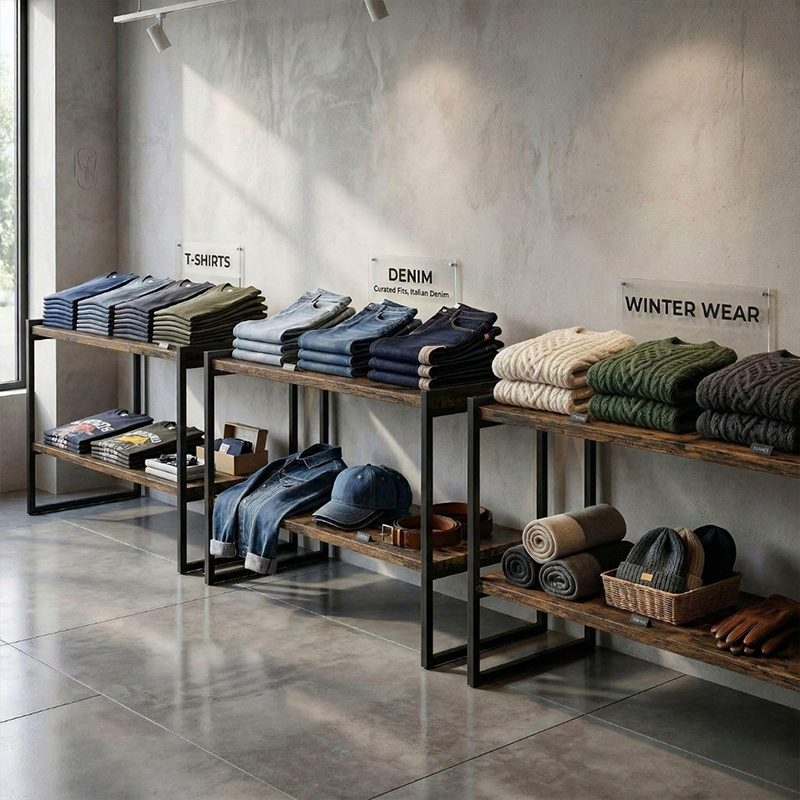
120 cm Metal Frame Display Table with Two Wood Shelves and Open Steel Sled Base
Brand Sintop
Product origin China
Delivery time 30days
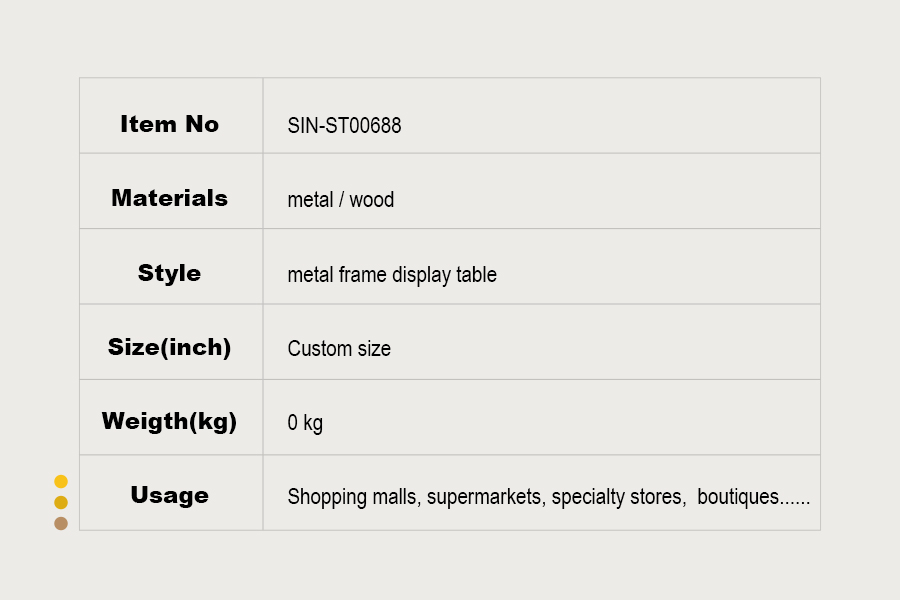
A metal frame display table measures 120 by 60 cm at 85 cm high, pairing a powder-coated steel frame with a natural wood top and one lower shelf. The open structure keeps sightlines clear, and no-slip foot pads hold it steady where casters would not.
Product Specifications
Key Features
Nothing blocks the sightline
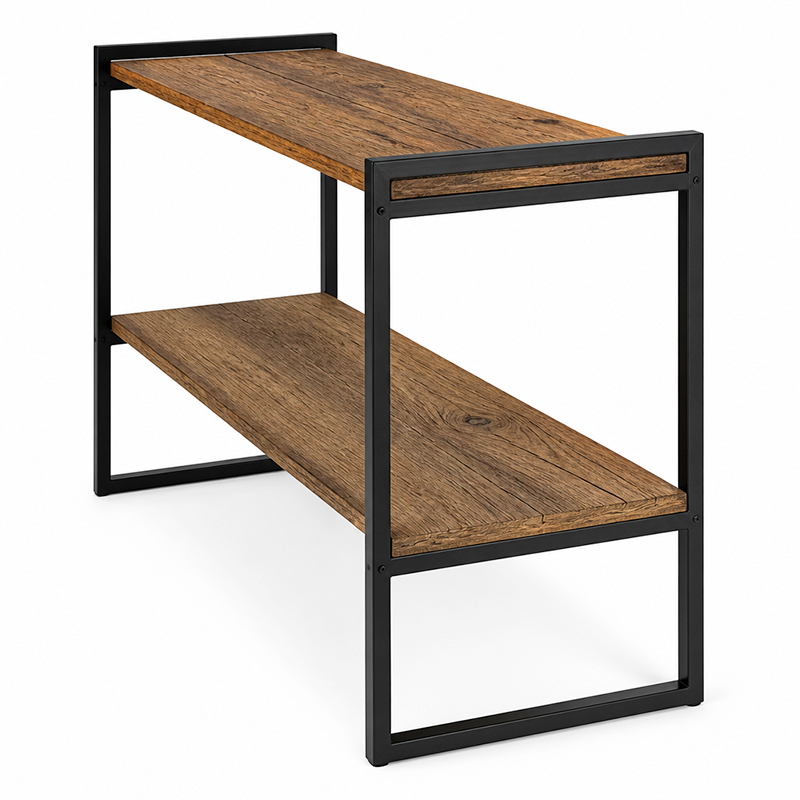
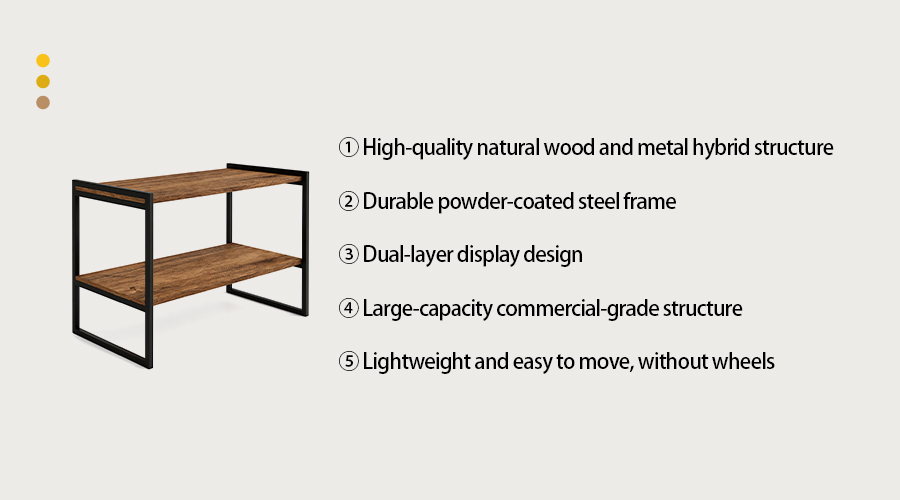
There is no back panel, no side infill and no plinth. A shopper looking along a row of these tables sees the stock on the second one as clearly as the stock on the first, which is what allows a shop to place several in a line without building a wall of product between the aisles.
It is meant to be repeated
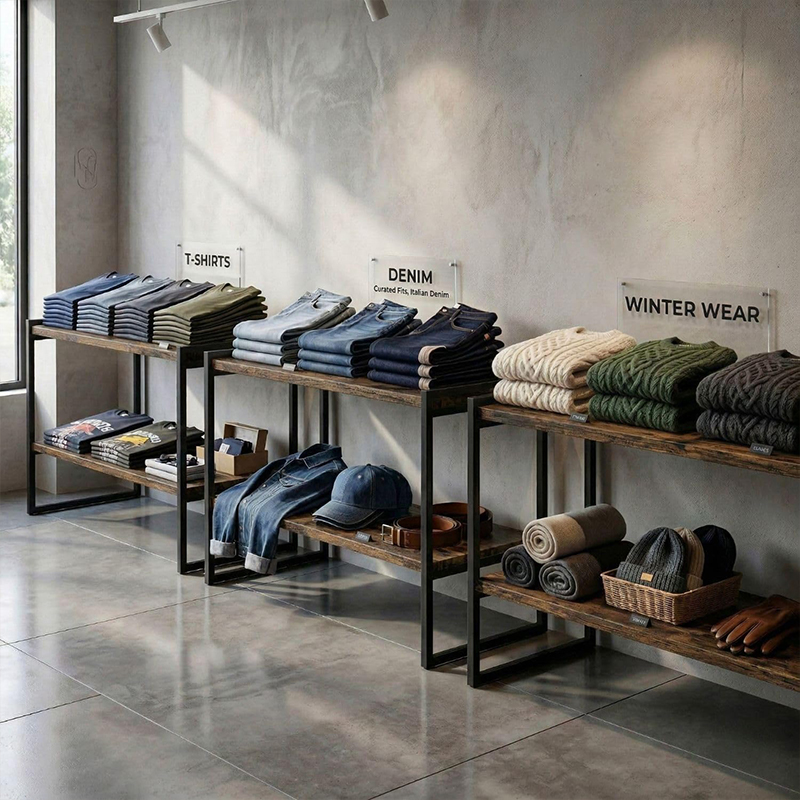
One of these is a table. Four of them, end to end at the same 85 cm height, read as a merchandising run without the cost of a wall system. The open frame is the reason: with a solid panel at each end, the joins would show as a series of boxes; with an open frame, the eye carries straight through.
Counter height, not coffee-table height
85 cm puts the top at the same working height as a retail counter, so a customer stands and handles stock rather than bending to it. For folded apparel that is the right height; it is also why this two tier wood and steel table works as a display-cum-packing surface in a small shop.
The lower shelf is backstock, not display
The gap between the two tiers gives a second, quieter plane for sizes, boxes or the rest of a folded run. Because the frame is open at both ends, staff reach it from either side without walking round — the small thing that keeps a table looking full at 5 pm.
No wheels, and that is deliberate
Casters make a fixture convenient and, in a busy shop, slightly unstable. This one sits on no-slip foot pads instead. It can still be moved — it is light enough to lift and reset — but it does not drift when a customer leans on it, and it does not need its brakes checked.
Steel that is doing structural work
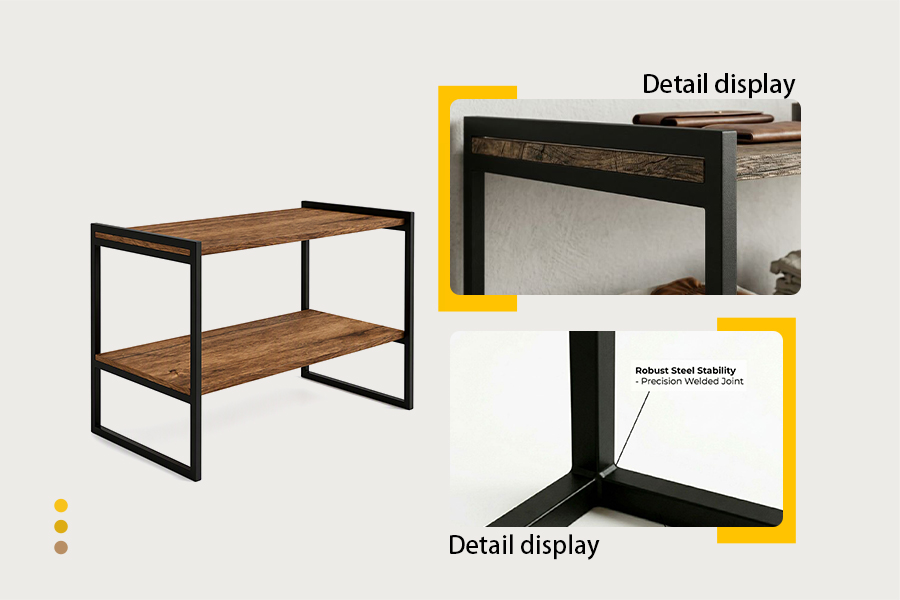
The frame is not a decorative surround. Two rectangular end frames carry both shelves, and the end frames are tied by the shelves themselves, which is what makes an open frame retail table rigid without a diagonal brace across the front.
Product Details
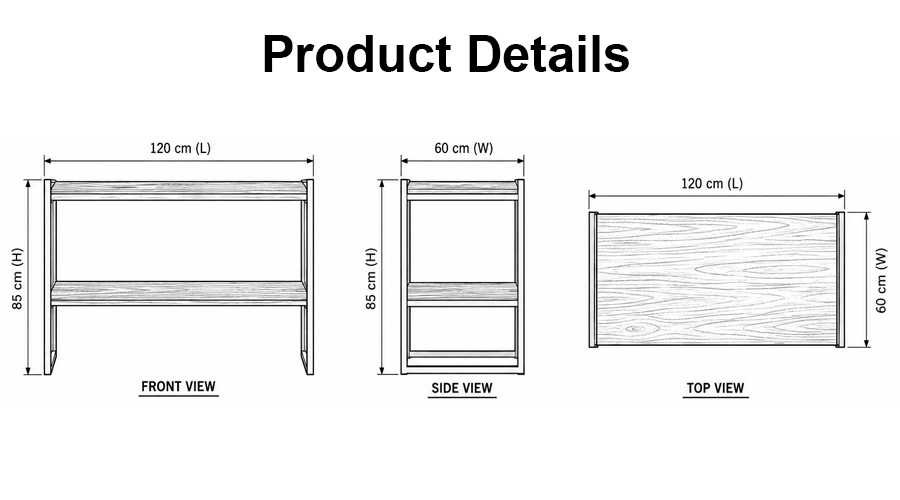
The tube. Powder-coated steel in a rectangular section, set on edge rather than flat so it resists bending across the 120 cm span. This is why the top does not dip in the middle when a customer leans on it.
The sled base. Each end finishes in a closed rectangle on the floor rather than four separate legs. A closed loop spreads load across the full footprint, sits flat on an uneven floor, and — important in a shop that gets mopped nightly — leaves no leg ends to catch a mop head.
The welded corners. The drawing calls out precision welded joints at every corner of the end frames. Welds, not brackets: a bracket joint creeps under repeated loading, a weld does not. This is the difference between a table that is still square after two years and one that rocks.
The shelf mounting. The lower shelf sits between the two end frames, carried on the frame rather than on visible brackets. From the aisle, the shelf appears to float inside the steel rectangle — the detail that makes this read as furniture rather than as industrial racking.
The foot pads. Small pads under the sled base, called out as no-slip. On tile they stop the table walking; on timber they keep the black coating off the floor finish.
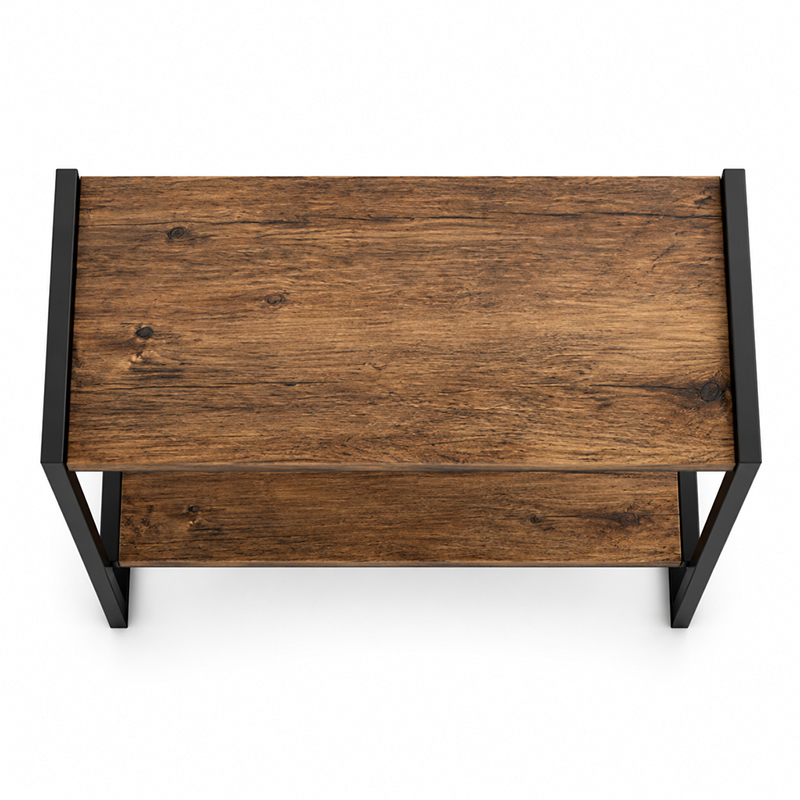
The timber. Natural wood finish on both surfaces, laid with the grain running along the 120 cm length so the long lines echo the steel. Colour varies board to board, which is normal for a natural finish and should be expected rather than treated as a fault.
The proportions. 120 by 60 cm is a two-thirds ratio, wide enough for a folded stack across the depth and long enough for three stacks along the length. 85 cm of height means the lower shelf clears the floor by roughly a knee, so it stays usable without being a bend-down job.
Application
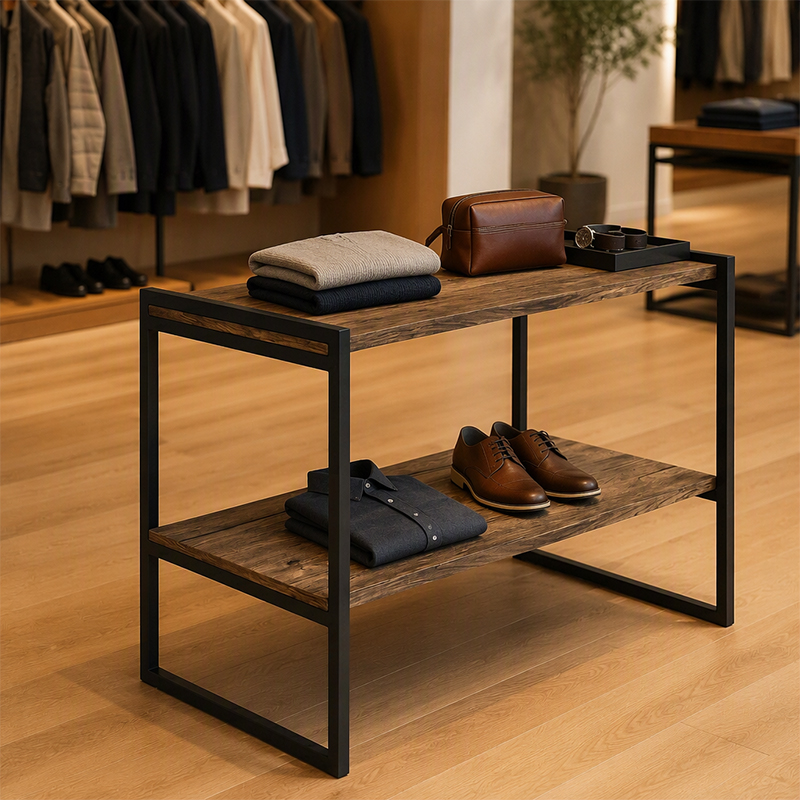
Fold-down apparel. T-shirts, knitwear, jeans, shirts. Two tiers hold a seasonal story with the backstock underneath, and several units in a line make a industrial style shop display table run that reads as one merchandising statement.
Footwear. A pair laid out on top, boxes on the lower shelf. The 60 cm depth takes a shoe box square, which is not true of narrower display tables.
Denim and workwear. The heavy black frame suits the category visually, and the open ends let a long run be browsed from both sides in a shop with a central aisle.
Leather goods and accessories. Bags and small leather goods on the top, packaging and dust bags below. The lower shelf being visible through the open frame is useful here: staff can see stock levels from across the floor.
Café and lifestyle retail. Beans, brewing kit, cups and boxed gifts on two levels, with the top doubling as a bagging surface. Fixed feet matter in a café where a table doubles as a service point.
Where it is the wrong answer. Stock that needs to be locked away, since there are no doors or drawers. Very heavy goods, since no load figure is published for this frame. And a shop that re-plans weekly, since moving it means lifting rather than rolling.
Ordering a Run, Not a Table
One height across every length. A fixed height merchandising table only works as a run if every unit is 85 cm, whatever its length. Because the height is set by the end frame rather than by the shelf, mixing a 120 cm unit with a shorter one does not break the line.
Repeat orders that match. Running a second store or a second season means matching an existing piece, not approximating it. The frame colour, timber tone and height are all specified on the drawing, so a repeat order is built to the same numbers rather than to a photograph.
Flat-pack that survives freight. Frames and shelves travel separately with edge protection between the timber pieces. That keeps the shipped volume down and gets a 120 cm table through a standard shop door without a crane or a window.
Joints you can inspect. Welded corners can be checked in ten seconds with a square. If a delivery arrives out of true, that is a transport problem and it is visible immediately, before the unit is loaded.
Documented, not assumed. The drawing gives length, width and height in centimetres with the plan view confirming the 120 by 60 cm footprint, so a fitter can mark the floor and check aisle widths before the container is loaded — and see exactly what the 60 cm depth does to a narrow walkway.
FACTORY VIEW
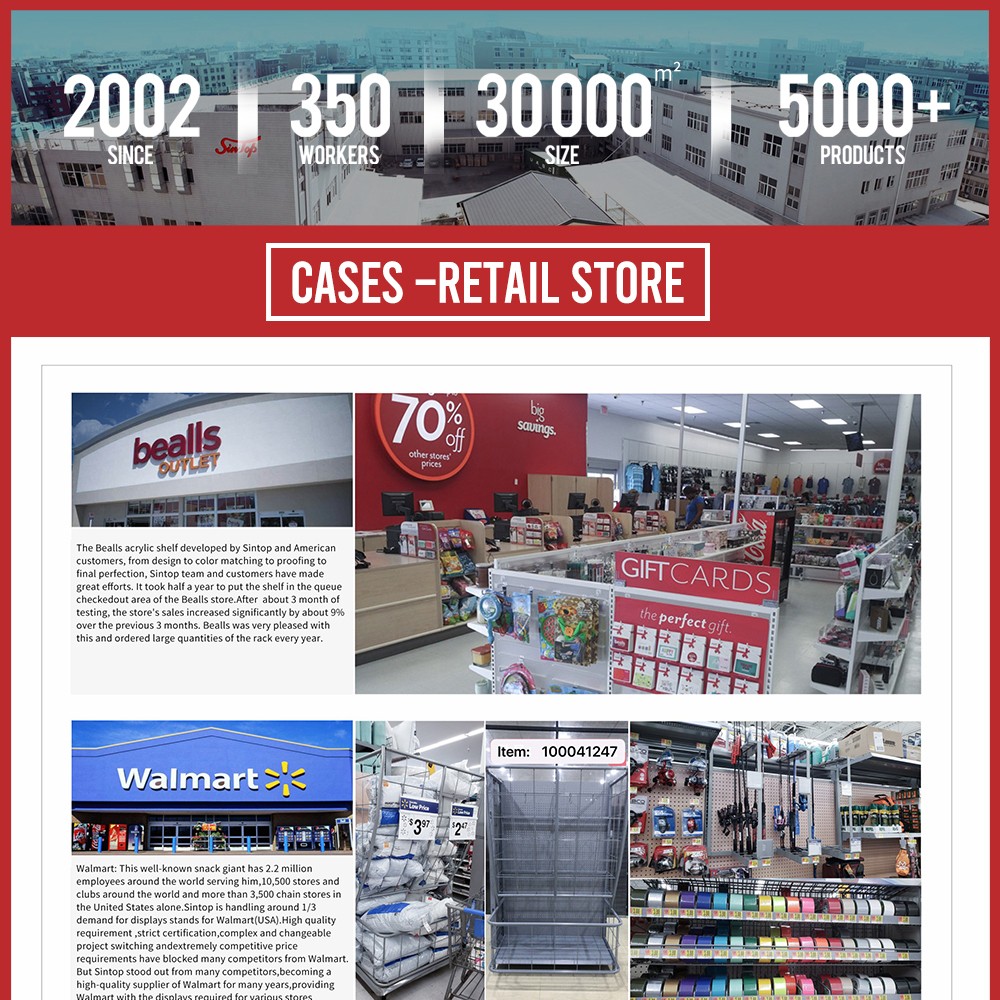
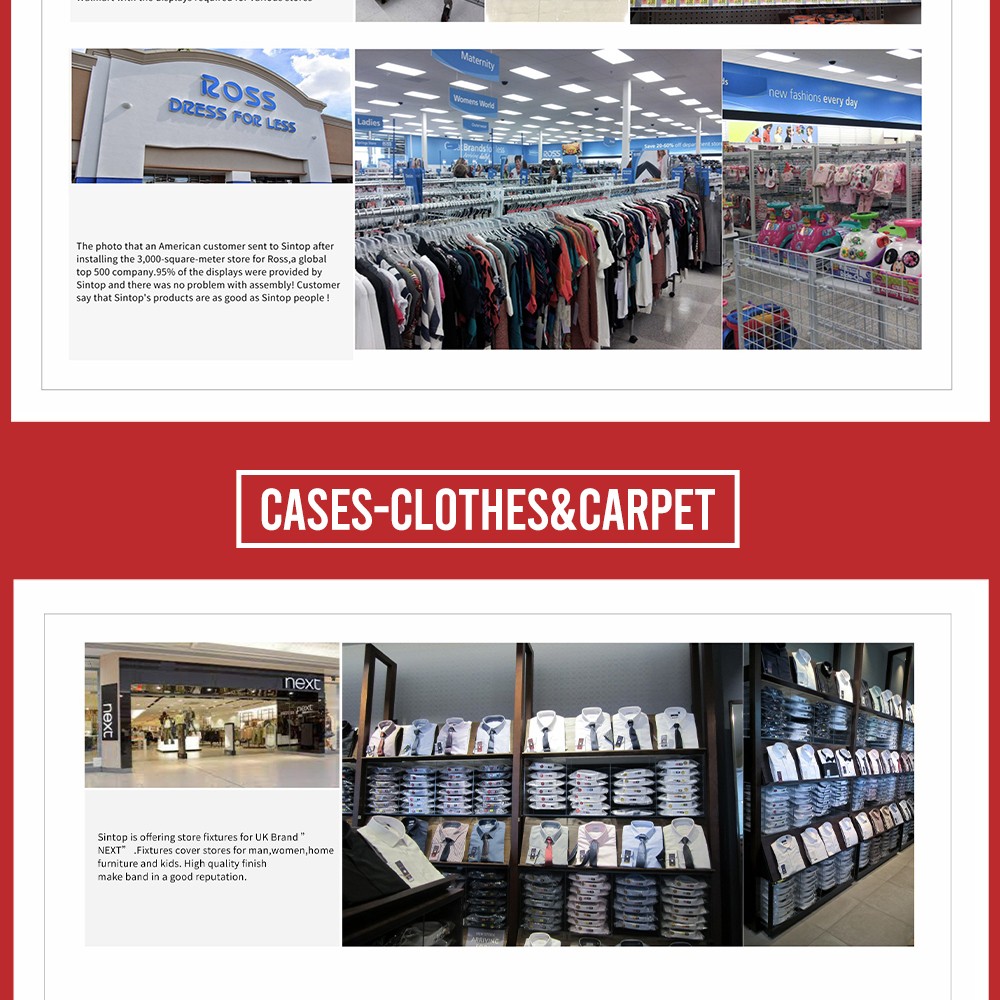
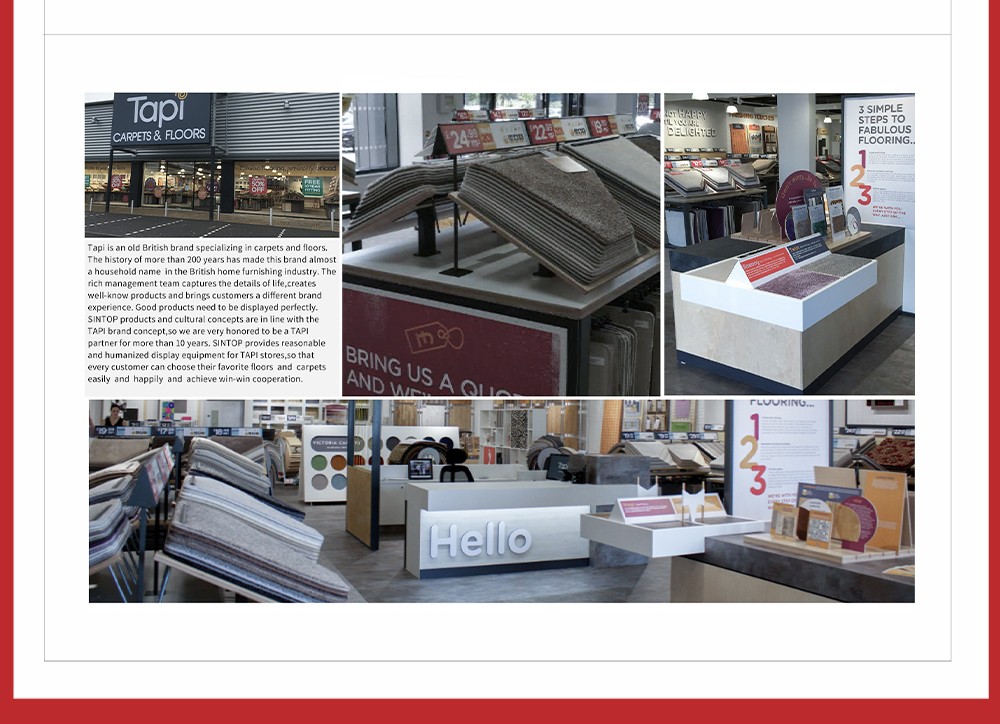
CASES SHOW
Certifications

OUR ADVANTAGE
1.Engineering from concept to detailed construction design
2.Strong project management throughout the manufacturing process
3.Attention to details
4. Production time to meet clients needs
5.IS09001/IS014001/OHSAS18001/SEDEX & UL-certificated factory
6.Good factory -Sintop is a company who develops partnership with clients through quality, service and honest communication
FAQ
1.When Sintop Started Business
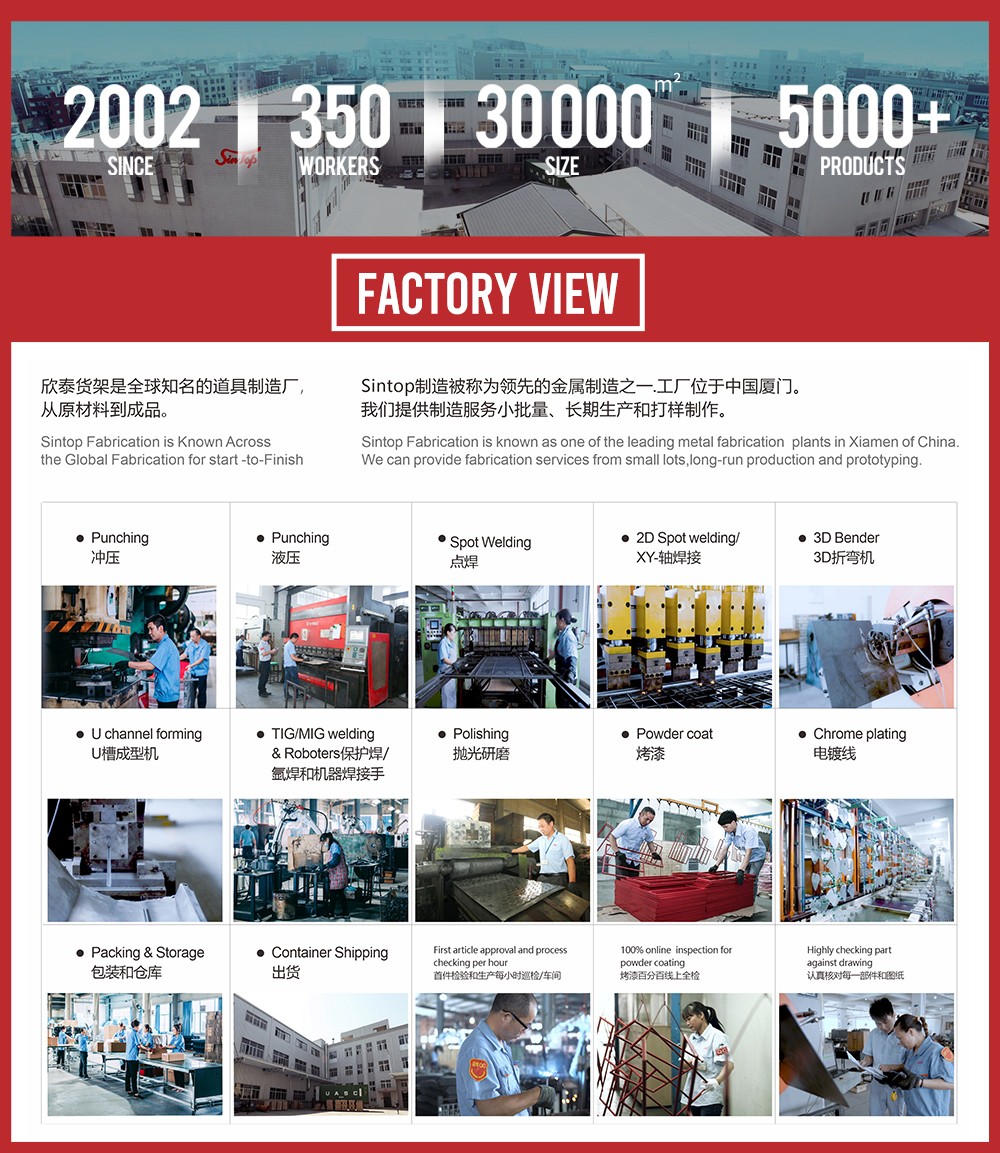
We started our business in 2002 under the name "Hanlong". In 2006, we registered the brand "Sintop" and began exporting directly, managing all orders in-house. Hanlong and Sintop belong to the same company and share the same owner.
2.Which countries do you mainly export to?
We mainly export to USA, UK, Russia, Germany, Australia, and France, serving international retail and brand clients with custom display rack solutions.
3.Do you have a minimum order quantity?
No, we do not have a minimum order. Any order size is welcome, whether it’s a single prototype or a large bulk order.
4.What is your production capacity and lead time?
New items: 3–5 weeks for tooling and production. Reorders: 2–4 weeks depending on the product type. We are flexible and always strive to meet your required delivery dates.
5.Which countries or regions do you serve?
Sintop’s custom display racks are shipped globally, with key markets in USA, Europe, and Australia. We work closely with retailers, brand stores, and display solution providers to deliver high-quality, tailored solutions.
6.Can you provide OEM or ODM services?
Yes, Sintop specializes in OEM and ODM custom display racks. Whether you have drawings or just an idea, we can design and manufacture according to your specifications.
7.What shipping methods do you offer?
Standard: Container shipments (20'/40'/40HC/45') or LCL. Urgent: Air freight or express delivery. We can also assist with freight coordination if needed.
8.How do you handle quality issues or missing items?
If any quality issues or missing merchandise occur, please contact our sales team immediately: Email: info@xm-hanlong.com / grace@xm-sintop.com Phone: +86-592-383-2652 / Mobile: +86-188-5920-1964 We take full responsibility and will replace or correct any issues promptly.
9.What payment terms and Incoterms do you accept?
Payment: T/T Incoterms: EXW, FOB, CIF, DAP, DDU,DDP We aim to make transactions smooth and flexible for international clients.
10.What types of display racks can Sintop manufacture?
Sintop can produce a wide range of custom retail display racks, including: Metal display racks (grid panels, wire racks, tubular structures) Wooden display stands (solid wood, plywood, MDF) Mixed-material solutions combining metal, wood, and acrylic, electronic and etc. All racks can be tailored to store layout, product type, and brand design requirements.
11.How does Sintop ensure the quality of its display racks?
Quality control is integrated at every stage: Raw material inspection for metals and wood Structural checks and welding inspections Surface finish tests (powder coating, chrome plated, wooden surface) Final assembly and stability checks Each display rack is carefully tested to guarantee durability, safety, and visual appeal before shipment.