

What Should Buyers Confirm Before Ordering a Grocery Store Display Project?
A fixture price is easy to obtain and hard to control. This brief separates project delivery, shopper-facing design and site-level replacement, then lists the drawings, samples and handover records a buyer should hold before production starts.
Fixture buying rarely fails at the price stage. It fails later, when a purchase order describes a shape but not a decision. Three phrases circulate in tender documents and search boxes, and they get treated as synonyms by everyone except the people who have to deliver against them. One describes a commercial project, one describes what a shopper meets in the aisle, and one describes work done inside a store that keeps trading. Read them as a single phrase and a tidy quotation turns into a site argument. The sections below take each reading in turn, then set out the records that make a supplier's offer checkable rather than persuasive.

Three Phrases, Three Buying Questions
Start with the noun each phrase attaches to. grocery store display commercial work is judged by what a project team can schedule, ship and hand over. modern grocery store display work is judged by what a shopper can see, reach and read at the shelf edge. grocery store display modern work is judged by what survives a live store, a fixed opening hour and a phased re-set. The words are nearly the same. The acceptance test is not.
Word order carries real weight here. Put the commercial word first and the buyer is asking about project delivery. Put the design word first and the buyer is asking about the shopper's view of the aisle. Put the change word last and the buyer is asking how existing fixtures get replaced while the tills keep running. A supplier who answers all three with the same photograph and the same unit price has answered none of them. A useful reply separates scope, drawing status, sample status and site responsibility before it quotes a number.

Delivery Is a Location Matrix, Not a Single Store
A chain order is a matrix before it is a purchase order. Rows are locations, columns are fixture types, and each cell carries a quantity, a finish, a delivery window and a named receiver. A cell left blank is a decision nobody has made. Two locations may share a standard bay and still differ on a local variation: a lower bulk stack, a different end panel, a service counter return. Until that matrix exists, every grocery store display commercial conversation drifts back to one store and one photograph.
The records that make a matrix enforceable are dull and specific. A bill of materials lists parts by code, not by description. A material and finish schedule names the substrate, the edge treatment and the colour reference for each visible surface. A packaging note says how parts arrive, how they are labelled by location, and what protection comes off before handover. A delivery, assembly and installation scope states who unloads, who fixes to the wall, who levels, who removes waste and who is on site when the doors open.
Ownership needs the same precision. Who holds the goods before installation, who insures them, who signs for damage found after the crates are opened, and who keeps spares and service records once the project closes? An offer that stops at the ex-works price leaves those questions to the site meeting. A grocery store display commercial package should end with acceptance and handover: a signed snag list, a marked-up drawing set, and one named person on each side who accepts the work.
Shopper-Facing Design Is Not a Style Label
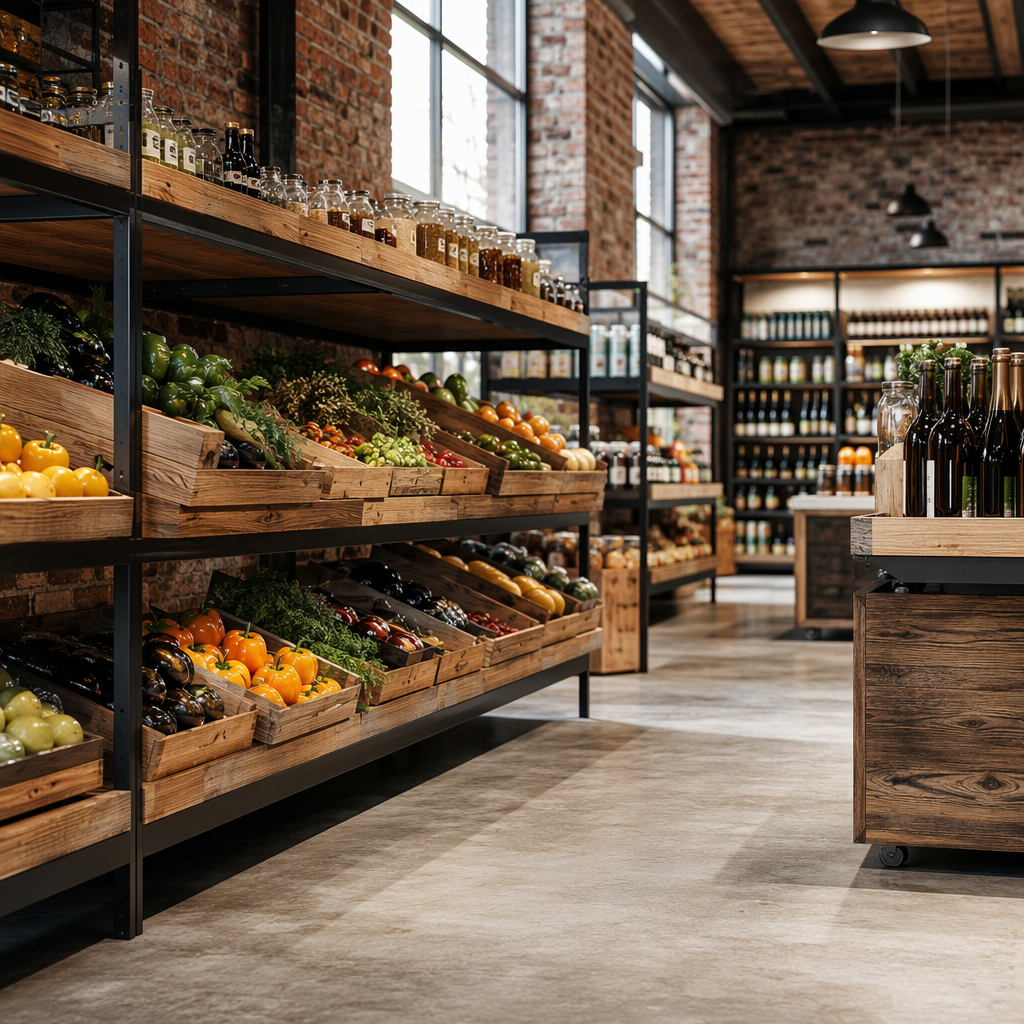
The design question is practical. Standing where the shopper stands, what can be seen, reached and read? Sightlines come first. A run that looks generous in plan can hide the top shelf of the next bay from the main approach, and a tall gondola can close off the aisle it was meant to open. Category hierarchy comes next: the fixture should make the department obvious before the brand, and the brand obvious before the variant.
Product and pack clarity is a measurement, not a taste. Face widths, shelf pitch, stop positions and the height of the front label on a tall carton decide whether a pack reads at a glance or has to be lifted. Price, promotion and signage need a defined home: a rail with a stated depth, a ticket strip at a stated height, a promo zone that does not eat the selling face. Low-clutter display rules belong in the brief, not in a store manager's memory. Leave them out and the first trading week invents its own layout.
A modern grocery store display brief should also describe the customer approach: where the trolley stops, how wide the passing space is, whether the end of the run invites a turn or blocks it. Cleaning surfaces and edges that trap dust are design decisions with a daily cost. Graphics and light interfaces are specified only when the brief specifies them; a light box is a power and service item. Sample approval is the last gate, and modern grocery store display approval means a physical unit reviewed against the drawing, not a rendering reviewed against a mood.
Replacement Begins With a Survey, Not a Catalogue
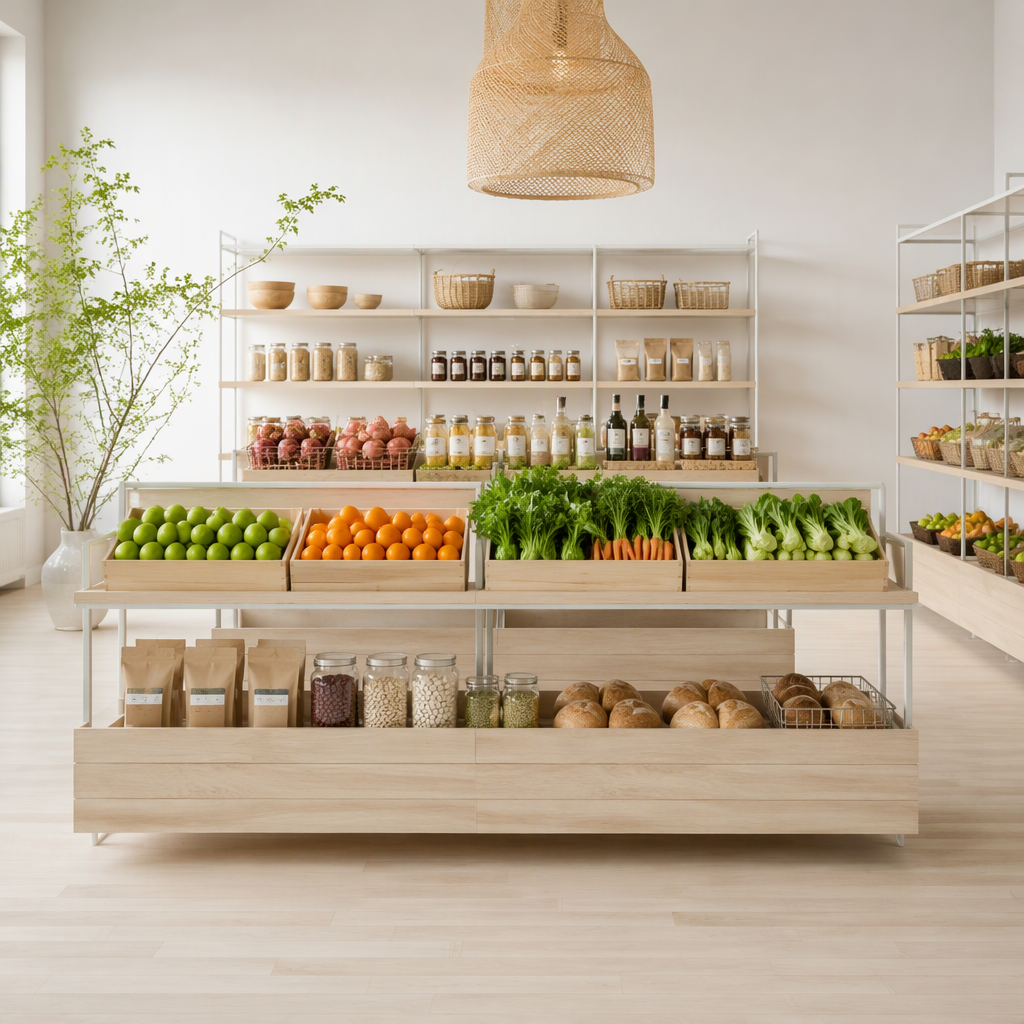
Replacing fixtures in a trading store is a different job from fitting an empty shell. It starts with a survey of what is already bolted down: bay widths, wall condition, floor level, services at the wall, ceiling height, and the state of every unit being retained. From that survey comes a measured plan that puts existing, retained and removed elements on one drawing, because the interfaces between old and new are where site arguments begin. Nothing in that list comes from a catalogue dimension.
A grocery store display modern plan is a sequence, not a picture. Which aisles close first, where stock moves while they are closed, how the re-set is phased so a category is never off the floor for longer than agreed, and who authorises a change when a retained unit turns out to be out of tolerance. Change control needs a written route: a variation note, a price effect, a schedule effect and a signature. Without that route, the installer makes the call at seven in the morning.
Final drawings should record what was built rather than what was intended, including any deviation agreed on site. Responsibility splits cleanly only when it is written down. The store owner or its contractor holds the building, the floor, the power and the permit side. The installer holds the fixing and the finish. The supplier holds the drawing, the part and the shipment. A grocery store display modern schedule that names those three roles is easier to run than one that promises a smooth opening.

The Gate: Drawing, Sample, Acceptance
None of the above removes the need for a gate before money is committed. The gate has three checks. First, a drawing that carries dimensions, fixing points and interfaces, issued at a stated revision and signed by the buyer. Second, a sample or first-article unit that matches the drawing on material, finish and edge, approved in writing before the batch runs. Third, an acceptance route at the end: what is inspected, by whom, against which document, and what happens to a snag.
A skeptical buyer also separates what a supplier controls from what it does not. Design, prototyping, production and shipment are supplier work. Handling on site, building condition, local rules and a retailer's own operating decisions belong to the parties responsible for them. A supplier that offers an outcome beyond its scope is describing confidence, not control. Ask instead for the drawing register, the sample record and the acceptance form, and check that the names match the people on site.
Price comparison becomes meaningful only after those records exist. Two quotes for the same bay can differ by the edge band, the shelf adjustment, the packaging, the installation labour or the spares included, and a line-by-line comparison shows which. Hold the cheapest quote to the same schedule of scope. A quote that cannot answer on the same terms is missing scope, not offering a discount.
Comparison table
| Phrase | What the buyer is really asking | Records to demand | Where it goes wrong |
|---|---|---|---|
| grocery store display commercial | How a multi-site order is scheduled, packed, shipped and handed over | Location matrix, bill of materials, finish schedule, install scope, handover list | One store quoted for a whole chain |
| modern grocery store display | What a shopper sees, reaches and reads at the shelf | Elevations with sightlines, sample approval record, signage and price positions | Rendering approved, pack fit never tested |
| grocery store display modern | How existing fixtures are surveyed, phased and replaced in a live store | Measured plan, retained and removed list, change control route, final drawings | Installer decides the interfaces on site |
Questions buyers ask
Are fixture quotes comparable between suppliers?
Only once scope is written down. Ask each supplier to price the same bill of materials, the same finish schedule and the same installation boundary, then compare line by line.
What does a sample approval need to show?
The material, the edge treatment, the finish and the hardware position, checked against the drawing revision. Approval should be in writing and tied to a part code.
Who owns the interface between an existing wall and a new bay?
Whoever the contract names. The usual split gives the building and the floor to the store owner or its contractor, and the fixing and finish to the installer.
How should a phased re-set be scheduled?
Aisle by aisle, with stock movement and a category downtime limit agreed before the first bay closes. Every phase needs its own sign-off.
Sintop Value
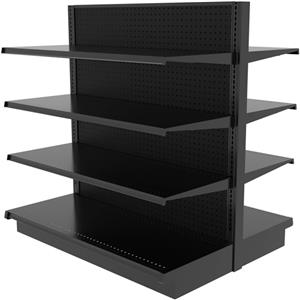
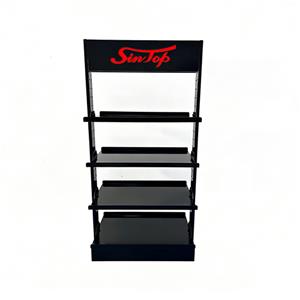
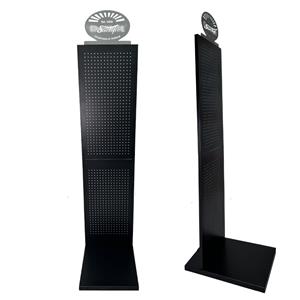
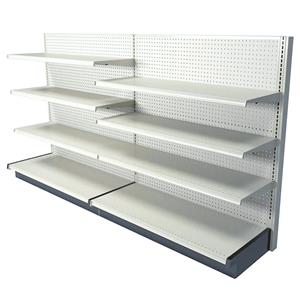
Sintop supports grocery retailers and project buyers with customized metal and wood display fixtures, including gondola shelving, shelves, brackets and food display structures. From design and prototyping to production and shipment, Sintop helps buyers define materials, dimensions, finishes and packaging before production begins. Each project is supported by its own drawings, sample approval and agreed acceptance requirements, helping reduce uncertainty in multi-location orders and store renovation projects.

Contact information
Website: www.sintopfixtures.com
Wechat/WhatsApp: +86 15980885084
Email: elly@xm-sintop.com

FAQ
1. What types of display racks can Sintop provide?
We offer a wide range of custom retail display racks, including metal display racks, wooden display stands, Gondola shelving, grid panels, and mixed-material solutions, tailored to your store layout and brand identity.
2. Can I order a single unit or prototype?
Yes, no minimum order is required. We can produce prototypes or single units as well as large-volume orders.
3. How long does it take to receive an order?
New items: 3–5 weeks for tooling and production.
Reorders: 2–4 weeks depending on product type.
We are flexible and strive to meet your required delivery dates.
4. Can Sintop handle OEM or ODM projects?
Yes, we specialize in OEM and ODM solutions, turning your ideas or drawings into custom, high-quality display racks.
5. How does Sintop ensure quality?
Every display rack undergoes material inspection, welding and structural checks, surface finish testing, and final assembly inspection to ensure durability, safety, and visual appeal.