

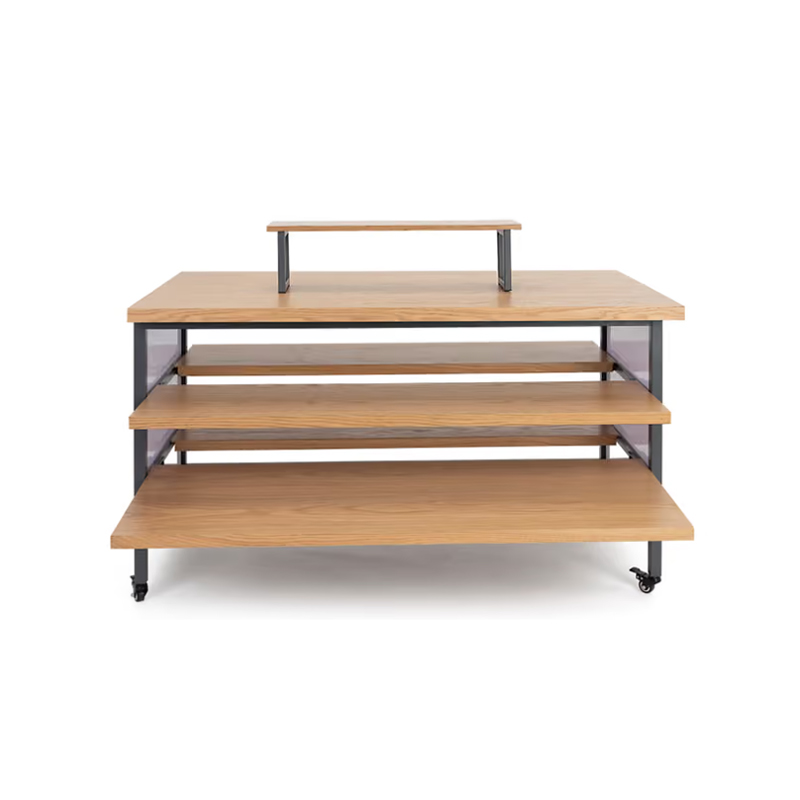
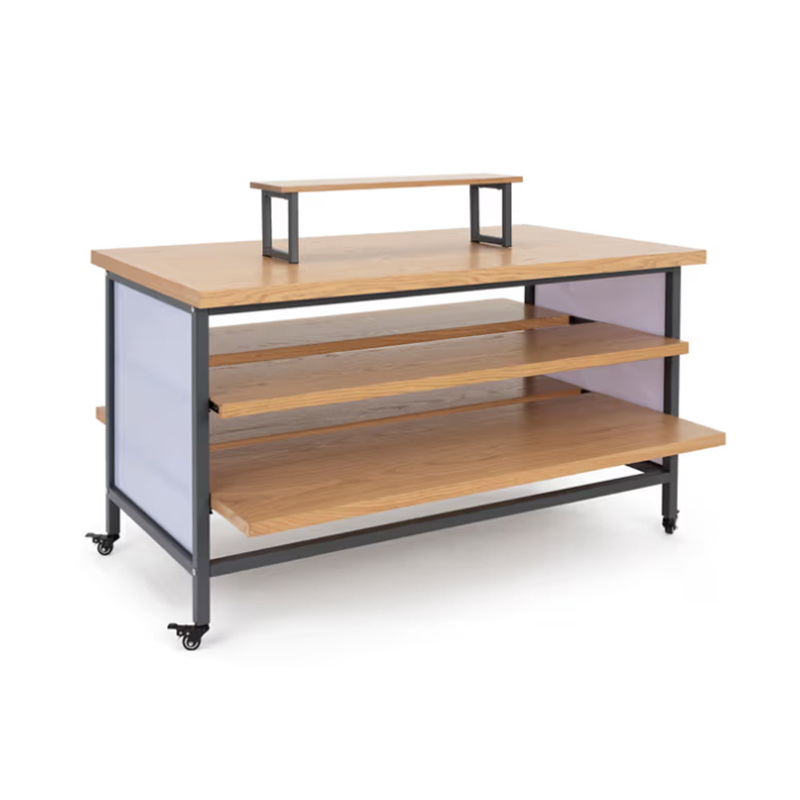
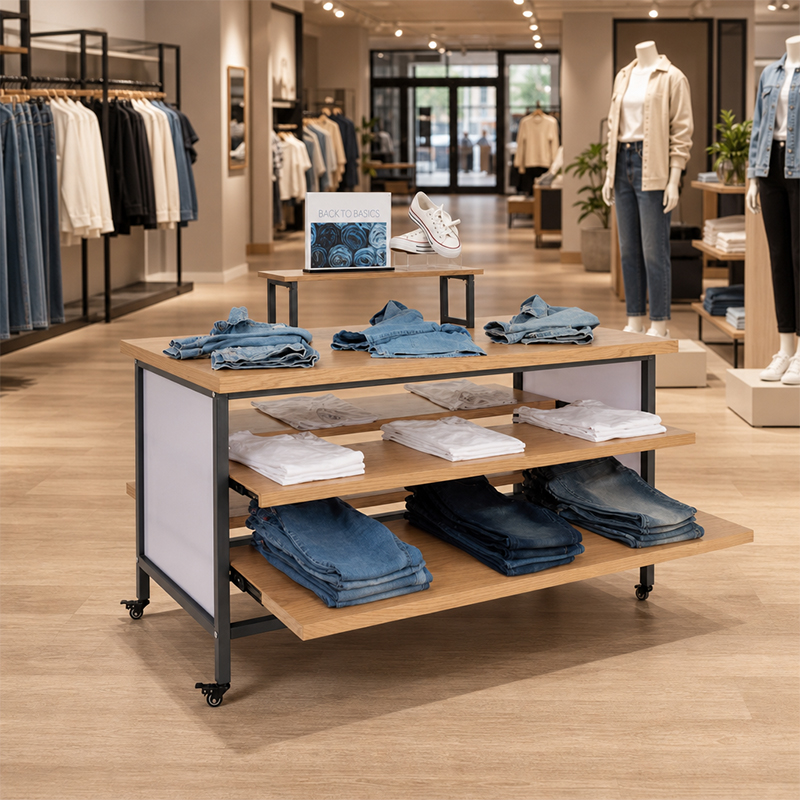
56.75 in Mobile Retail Display Table with Pull-Out Shelves, Acrylic Ends and Oak Riser
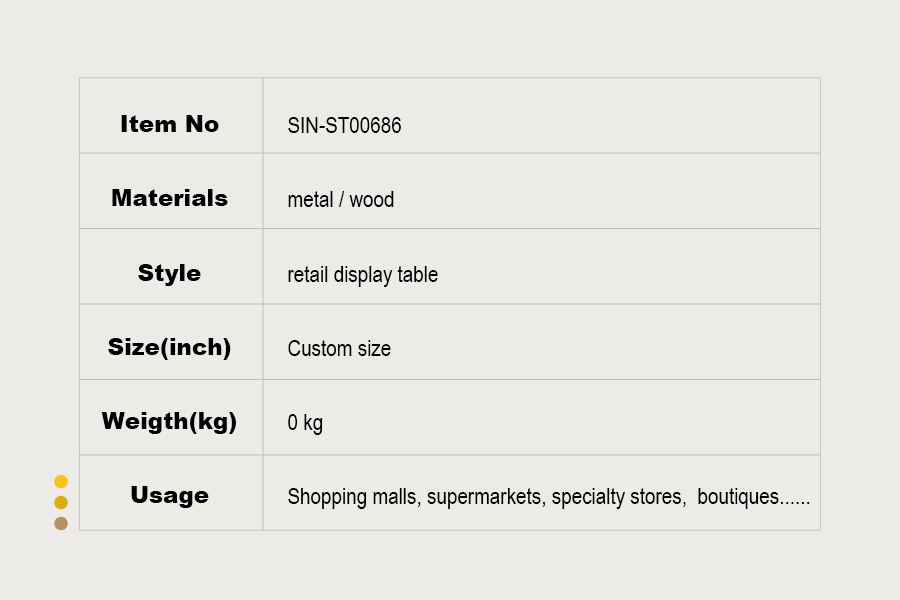
Brand Sintop
Product origin China
Delivery time 30days
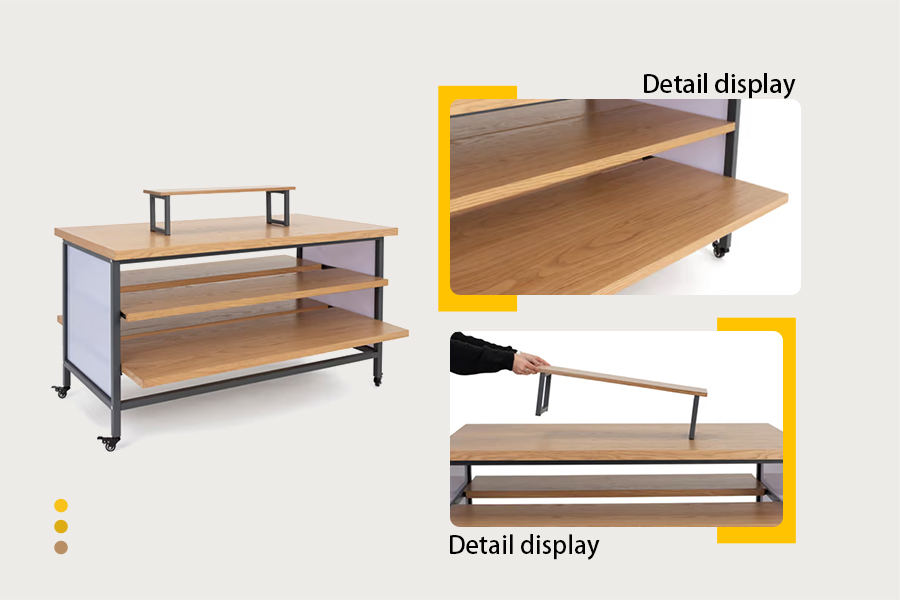
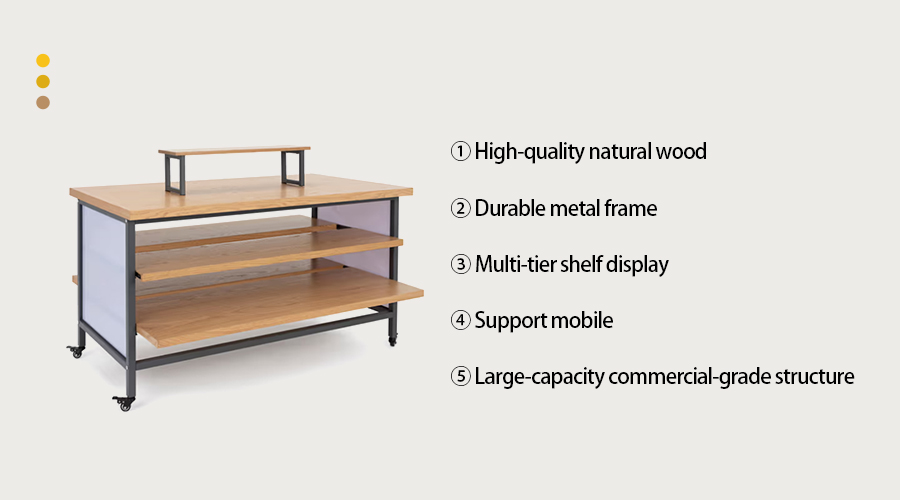
A mobile retail display table measures 56.75 by 40 inches with a 25.50 inch working surface and a removable 6 inch oak riser. Two lower shelves slide out on glides, frosted acrylic panels close each end and four locking casters move the whole island.
Product Specifications
Key Features
Reach: the shelf comes to the person
On a normal folding table, the second and third rows are pasted by hand at full stretch, and whoever stacks them gets it wrong by the third fold. Here both lower shelves ride on glides and pull out past the edge of the top. Staff fold and place from above, with both hands free, standing square to the table instead of leaning into it.
Depth: 40 inches that actually gets used
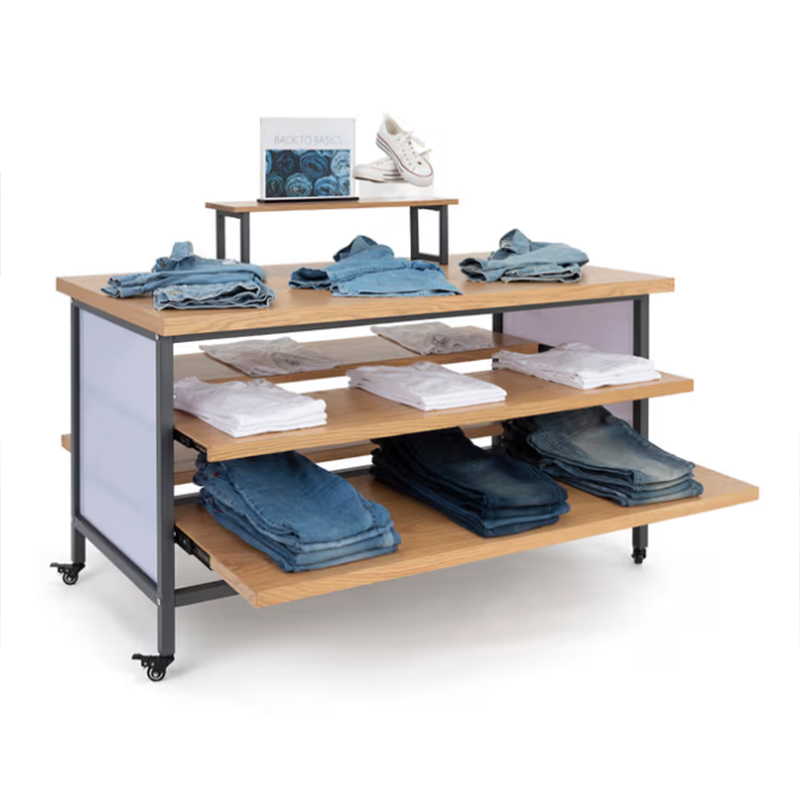
A 40 in deep table without moving shelves is a display that only sells the front 15 in. The pull out shelf apparel table solves the arithmetic: the front third is shopper-facing, the middle third comes forward on the glide when a customer digs for a size, and the back row is a restock reserve that nobody has to climb over stock to reach.
Height: lower than a work table, higher than a coffee table
At 25.50 in, the top sits below a standard counter, which is where folded goods want to be read from — you look down onto a stack, not up at it. A 30 in table forces the stack to be tall enough to see, and tall stacks collapse. The lower surface keeps each pile two or three folds deep and lets the customer see the whole fan of colour at a glance.
Focus: a riser that can leave
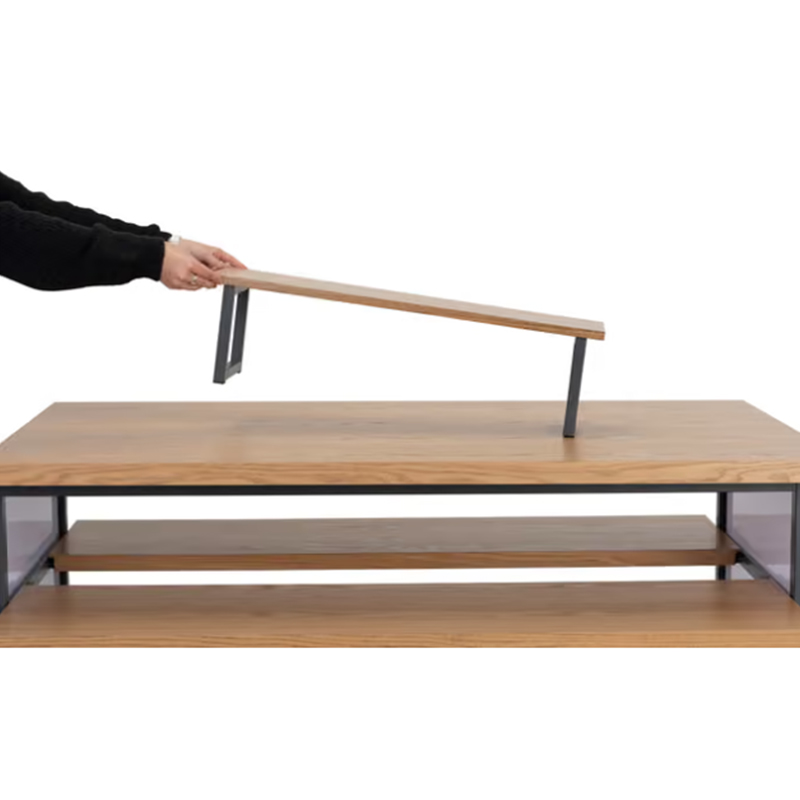
The 20 in riser lifts the one item the store is actually pushing — a folded look, a new wash, a shoe, a small sign. It stands on rubber pads, so it can be lifted off entirely on a day when the table needs the full top. That is the difference between a fixture a merchandiser uses and one they work around.
Sides: closed enough to look finished, open enough to see through
Frosted acrylic closes the two ends. It hides the raw shelf edges and the glide tracks from the aisle, it stops stock sliding off the end, and because it is frosted rather than opaque, the end of the table still glows with the light coming through from the other side instead of going flat black.
Movement: the whole island relocates
Four casters, all lockable. A store can pull the table into the entrance for a weekend drop and push it back against the denim wall on Monday, and the floor plan never has to be redrawn.
Product Details
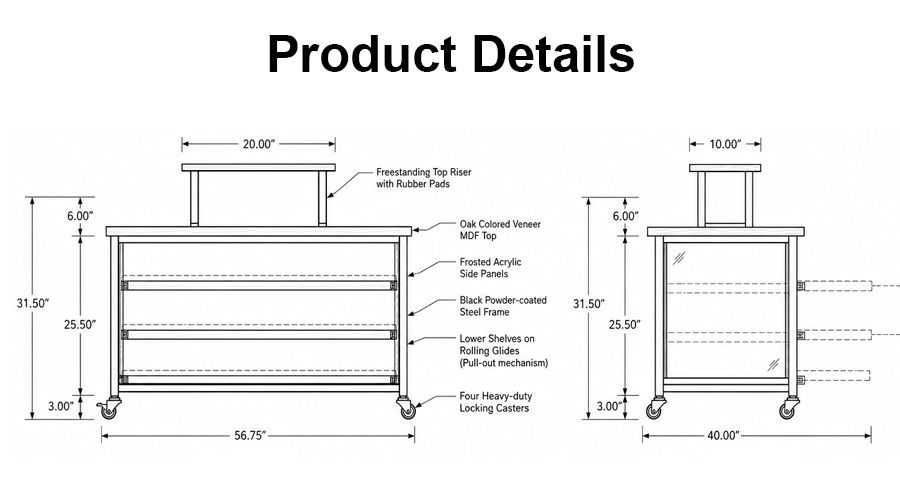
56.75 in wide. Wide enough for two people to fold from opposite ends without elbowing, and for three fold stacks across with a gap between them. Narrow enough to sit mid-floor without swallowing an aisle.
40.00 in deep. This is the number that dictates the design. Forty inches is roughly the depth of a full denim wall pulled out flat, which is what makes the table useful as a mid-floor restock point. It only works because the shelves slide: a fixed 40 in depth is a display where two-thirds of the stock is invisible.
25.50 in working height. Chosen for viewing angle, not for standing comfort. A shopper looks down at roughly 30°, and at 25.50 in that angle lands on the middle of the top stack.
6.00 in riser, 20.00 in wide, 10.00 in deep. Tall enough to lift an object above the fold line, shallow enough not to overhang the top, and narrow enough to leave the rest of the surface free. It is listed as freestanding with rubber pads, so it is a component rather than a permanent build.
3.00 in base clearance. Enough for the casters to swivel and for a mop or vacuum head to pass under the frame. On a dark floor it also puts a shadow line under the table, which stops a heavy island from looking like it is sinking into the ground.
The frame. Black powder-coated steel perimeter with the acrylic captured in it. The frame is what gives the table its straight edge over 56.75 in and what the glides are mounted to; an all-timber carcass at this width would need a centre leg.
The finish. This oak veneer merchandising table reads warm against the black frame, and veneer on MDF is the reason the top stays flat across the span. Solid boards at this width cup and split in dry shop air; veneered MDF does not.
Application
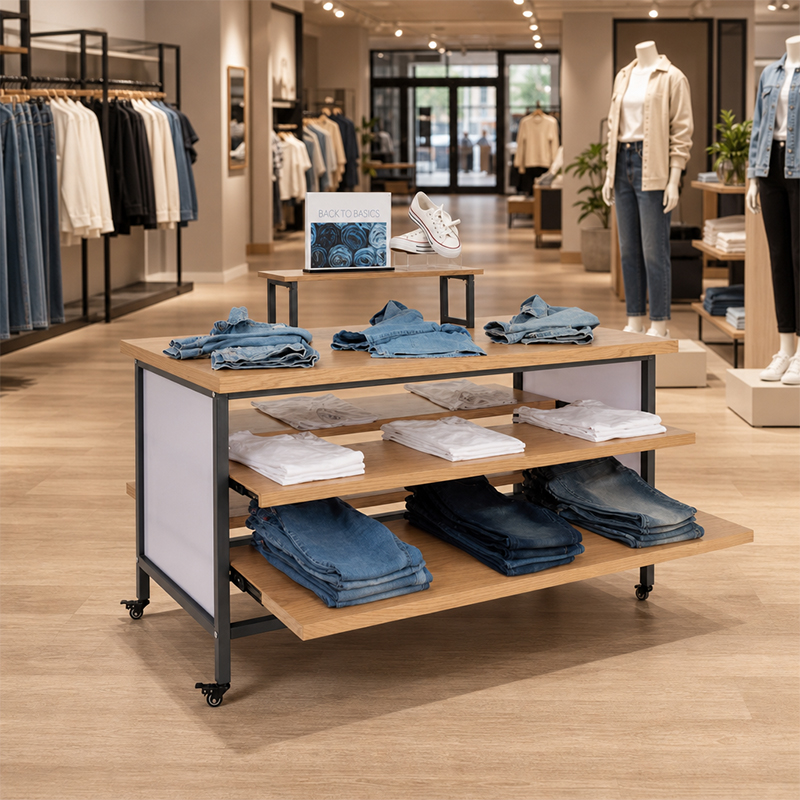
Denim walls and denim floors. The obvious case, and the reason the drawing exists: three stacks of jeans across the top, folded shirts on the upper pull-out, denim on the lower, a look board on the riser.
Knitwear and seasonal layers. A denim display table with riser in knitwear is a stack-height exercise: two folds per pile, colour fanned left to right, the riser holding the one cable knit the buyer wants seen first.
Footwear tables. Pairs laid heel to toe across the top, boxes on the pull-outs underneath. The 40 in depth means a full size run stays on the table instead of going back to the stockroom.
Lifestyle and gift. Candles, ceramics, boxed sets and small leather goods sit better at 25.50 in than at counter height, and the frosted ends give the table a finished look from any approach.
Beauty and gift-with-purchase. Promotional sets on the riser, full-size stock on the pull-outs. When the promotion ends, the riser comes off and the table reverts to a standard island.
Where it will not fit. A narrow aisle. With shelves pulled out, this fixture needs clearance beyond its 40 in footprint, so check the walkway before specifying it mid-floor. It is also the wrong choice for hanging garments — there is no rail and no height for one.
Four Things It Does for the Staff
Restocking stops being a two-person job. Case packs come off the delivery, get opened on the top, and go straight onto a pull-out shelf at working height. Nobody lifts a full carton over their shoulder to reach a back row.
Refacing takes a minute, not ten. At close, the shelves slide out, the front folds get straightened, the shelves go back. The freestanding clothing display island keeps its face overnight because there is no deep dark shelf for stock to slide to the back of.
Resets are physical, not contractual. Locking casters mean a promotion reset is a push rather than a planogram meeting. The same table does denim in spring, knitwear in autumn, gift sets in December.
Cleaning under it is possible. A 3.00 in base clearance and four casters mean the floor under the table gets swept, which is more than can be said for most plinth-based islands.
And it arrives buildable. Frame, top, shelves, glides, acrylic, riser and casters ship knocked down with edge protection. That keeps freight volume down and gets the piece through a normal shop door, which matters more often than buyers expect.
FACTORY VIEW
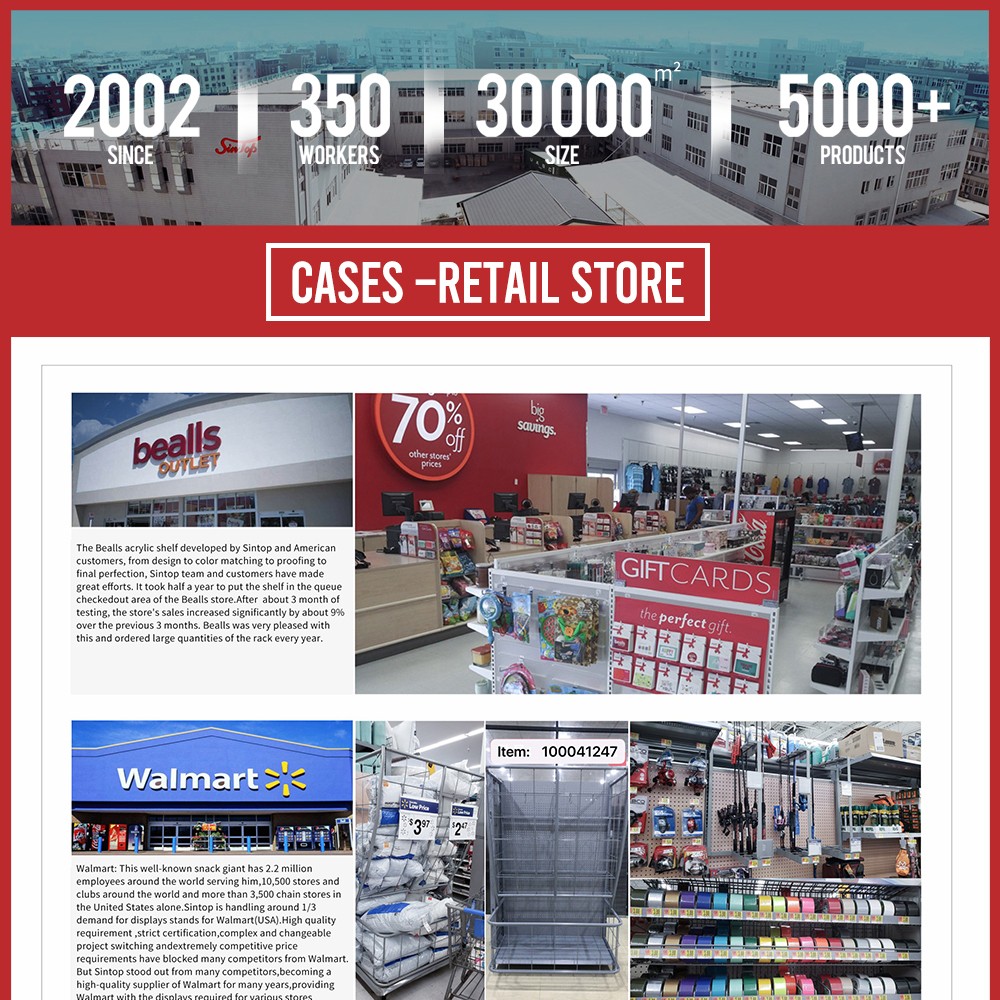
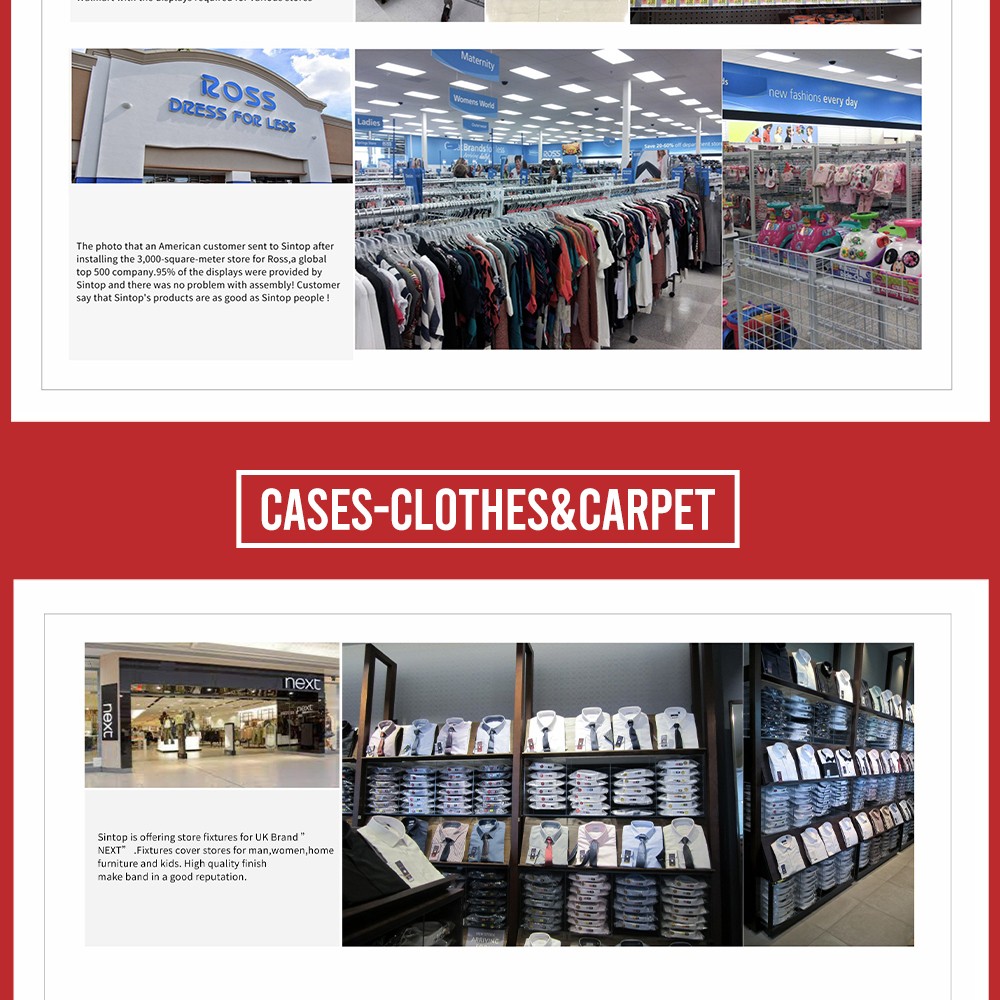
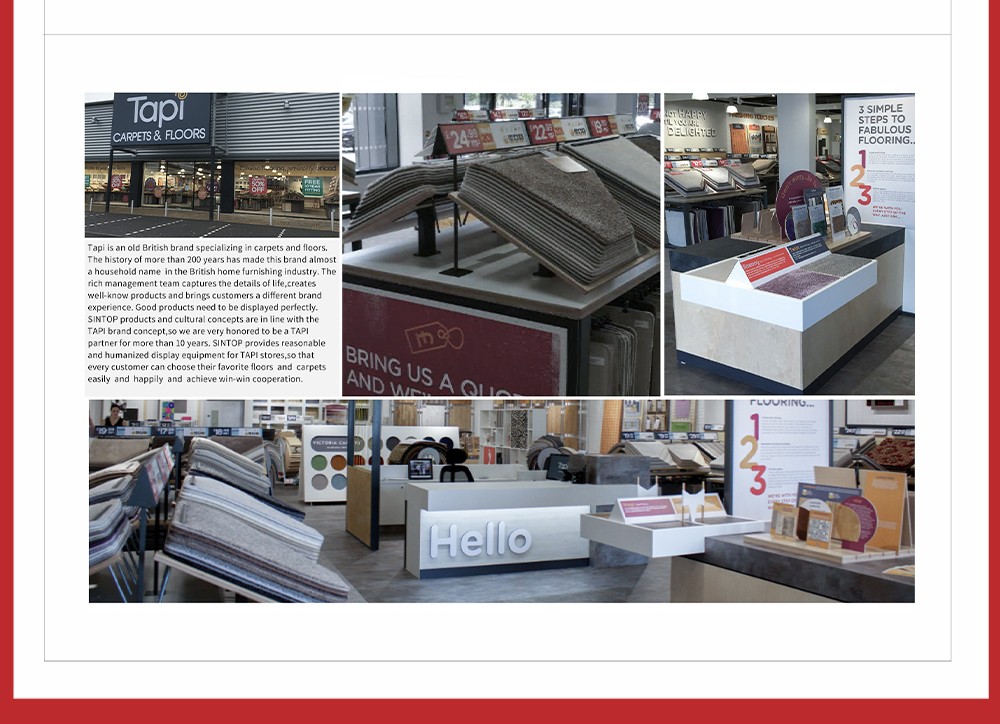
CASES SHOW
Certifications

OUR ADVANTAGE
1.Engineering from concept to detailed construction design
2.Strong project management throughout the manufacturing process
3.Attention to details
4. Production time to meet clients needs
5.IS09001/IS014001/OHSAS18001/SEDEX & UL-certificated factory
6.Good factory -Sintop is a company who develops partnership with clients through quality, service and honest communication
FAQ
1.When Sintop Started Business
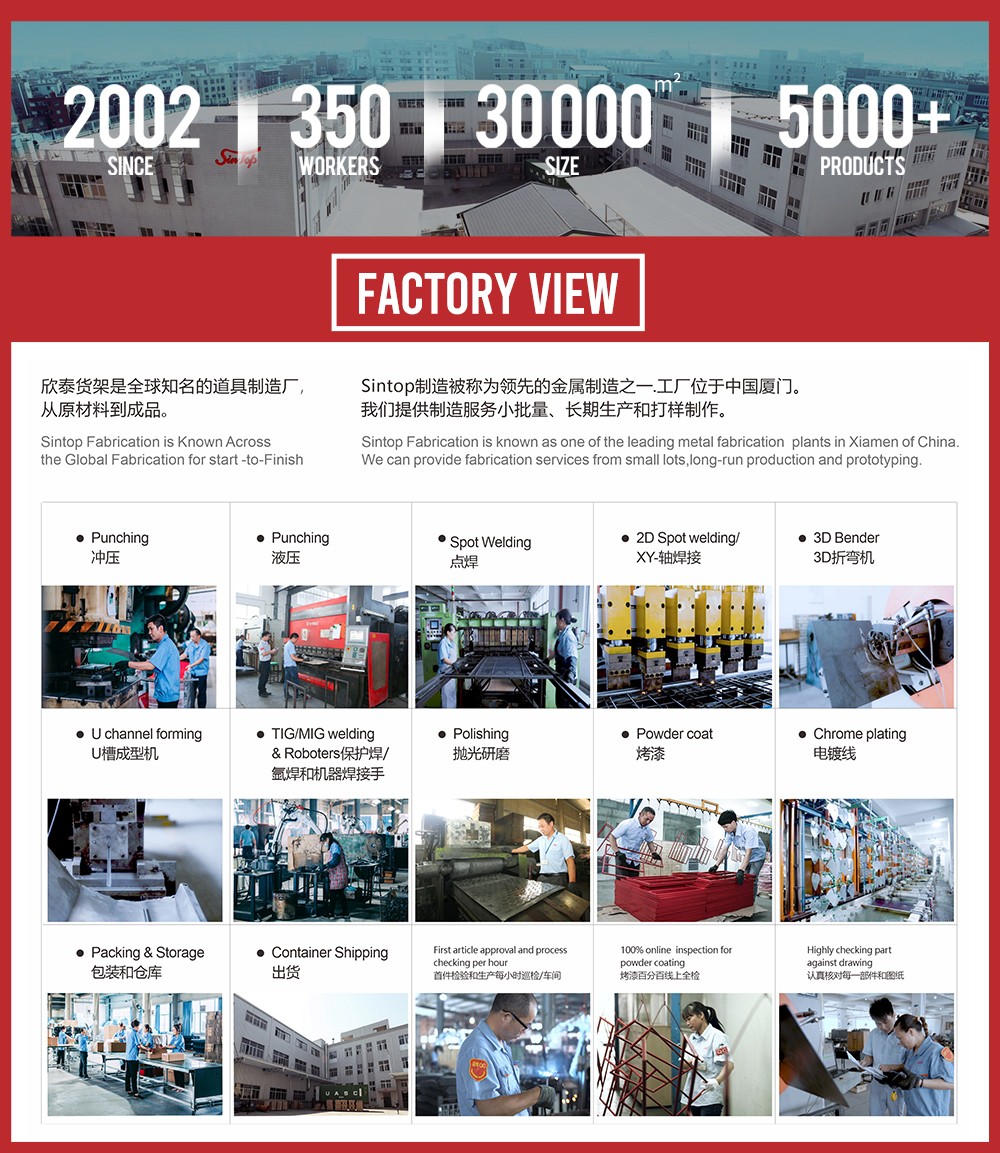
We started our business in 2002 under the name "Hanlong". In 2006, we registered the brand "Sintop" and began exporting directly, managing all orders in-house. Hanlong and Sintop belong to the same company and share the same owner.
2.Which countries do you mainly export to?
We mainly export to USA, UK, Russia, Germany, Australia, and France, serving international retail and brand clients with custom display rack solutions.
3.Do you have a minimum order quantity?
No, we do not have a minimum order. Any order size is welcome, whether it’s a single prototype or a large bulk order.
4.What is your production capacity and lead time?
New items: 3–5 weeks for tooling and production. Reorders: 2–4 weeks depending on the product type. We are flexible and always strive to meet your required delivery dates.
5.Which countries or regions do you serve?
Sintop’s custom display racks are shipped globally, with key markets in USA, Europe, and Australia. We work closely with retailers, brand stores, and display solution providers to deliver high-quality, tailored solutions.
6.Can you provide OEM or ODM services?
Yes, Sintop specializes in OEM and ODM custom display racks. Whether you have drawings or just an idea, we can design and manufacture according to your specifications.
7.What shipping methods do you offer?
Standard: Container shipments (20'/40'/40HC/45') or LCL. Urgent: Air freight or express delivery. We can also assist with freight coordination if needed.
8.How do you handle quality issues or missing items?
If any quality issues or missing merchandise occur, please contact our sales team immediately: Email: info@xm-hanlong.com / grace@xm-sintop.com Phone: +86-592-383-2652 / Mobile: +86-188-5920-1964 We take full responsibility and will replace or correct any issues promptly.
9.What payment terms and Incoterms do you accept?
Payment: T/T Incoterms: EXW, FOB, CIF, DAP, DDU,DDP We aim to make transactions smooth and flexible for international clients.
10.What types of display racks can Sintop manufacture?
Sintop can produce a wide range of custom retail display racks, including: Metal display racks (grid panels, wire racks, tubular structures) Wooden display stands (solid wood, plywood, MDF) Mixed-material solutions combining metal, wood, and acrylic, electronic and etc. All racks can be tailored to store layout, product type, and brand design requirements.
11.How does Sintop ensure the quality of its display racks?
Quality control is integrated at every stage: Raw material inspection for metals and wood Structural checks and welding inspections Surface finish tests (powder coating, chrome plated, wooden surface) Final assembly and stability checks Each display rack is carefully tested to guarantee durability, safety, and visual appeal before shipment.