

How Do Pharmacy Shelving Systems Support Better Store Layouts?
September 2026 signals: what the data does and does not say
The first job for a fixture buyer is to read a headline correctly. On 23 September 2026 the Google News US RSS feed surfaced general retail business coverage, not pharmacy or convenience fixture reporting. That feed helps with topic discovery; it does not rank products, and it is not a popularity claim for any shelf or gondola.
Three dated points are worth keeping in view. Reuters reported on 16 September 2026 that US retail sales rebounded sharply in August, up 1.2% month-to-month and 6.0% year-to-year, with the figures not adjusted for inflation. Reuters also reported on 11 September 2026 that US consumer sentiment deteriorated in September, with the Michigan reading at 47.8 against 51.7 in August and the one-year inflation expectation rising to 4.6 from 4.0. In the UK, the British Retail Consortium reported on 8 September 2026 that August total retail sales grew 0.7% year-on-year, with food up 2.6% and non-food down 0.8%.
The Reuters framing matters most: sales can improve while confidence stays fragile. Those numbers describe national demand and mood. They are context, not evidence that any fixture drives demand or sales, and they say nothing about what one store should buy.
One weather item is often quoted out of context. BBC Weather reported on 5 September 2026 that El Granado in southwest Spain reached 45.7C. That is an outdoor observation only. It says nothing about fixtures, coatings, food safety or store conditions, and it should not justify a material or finish choice.
A practical way to use these items is as a re-check trigger. Note the date, the geography and the scope beside each figure, then ask what it changes about a store layout. In most cases it changes nothing about a bay count, but it can justify revisiting an assumption about opening hours, staffing or the mix kept at the counter.
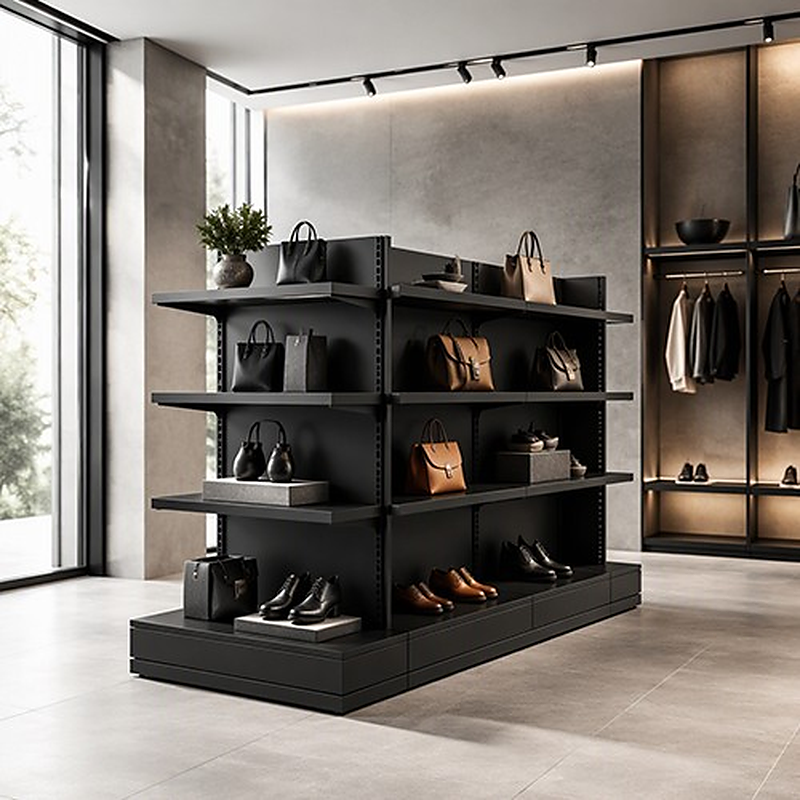
Pharmacy zoning, staff access and the privacy pathway
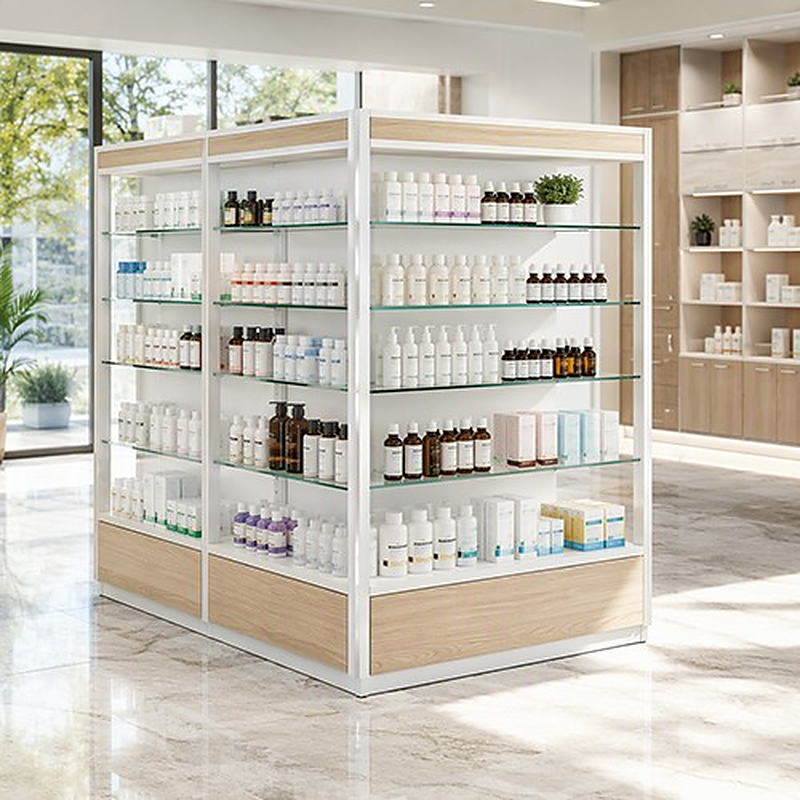
Pharmacy shelving systems are decided by zoning first, not by how a bay looks in a catalogue. A workable layout separates public browsing from staff-only stock, keeps the consultation area reachable, and lets a customer move to a private conversation without crossing a queue.
Begin with controlled product zoning. Decide which bays are open, which are staff-served and which sit behind a defined counter line. Then test staff access: can a team member reach a back bay, pull stock and return to the till without blocking an aisle? Shelf labels should be readable at the height they will actually sit, and label holders should survive routine cleaning.
Cleanability and rotation are the hard tests in pharmacy shelving systems, because dated stock moves quickly. Choose surfaces and edge profiles that can be wiped, agree whether shelves are fixed or adjustable, and make a first-in-first-out path obvious to staff without a wall diagram.
A consultation and privacy pathway is a layout question, not a legal one. This article does not interpret pharmacy legal requirements, prescription handling, storage temperatures, controlled-substance rules or any compliance standard. Those decisions belong to the responsible pharmacist and the relevant site regulator. Ask them before a drawing for pharmacy shelving systems is signed, not after.
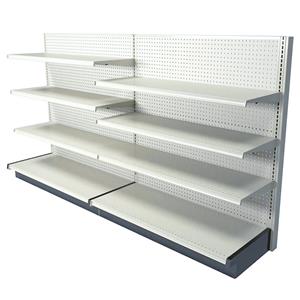
Treat pharmacy shelving systems as a system, not a shelf. Confirm that counters, back panels and label rails share one fixing method, so a later bay joins without a bespoke bracket. Request a layout drawing, a materials list, a sample shelf and the cleaning method in writing.
Check the counter line too. A short consultation counter placed beside open bays lets one team member serve both zones, while a deep bay that hides the till usually slows service. Measure the main walkway at its narrowest point before you fix a bay depth.
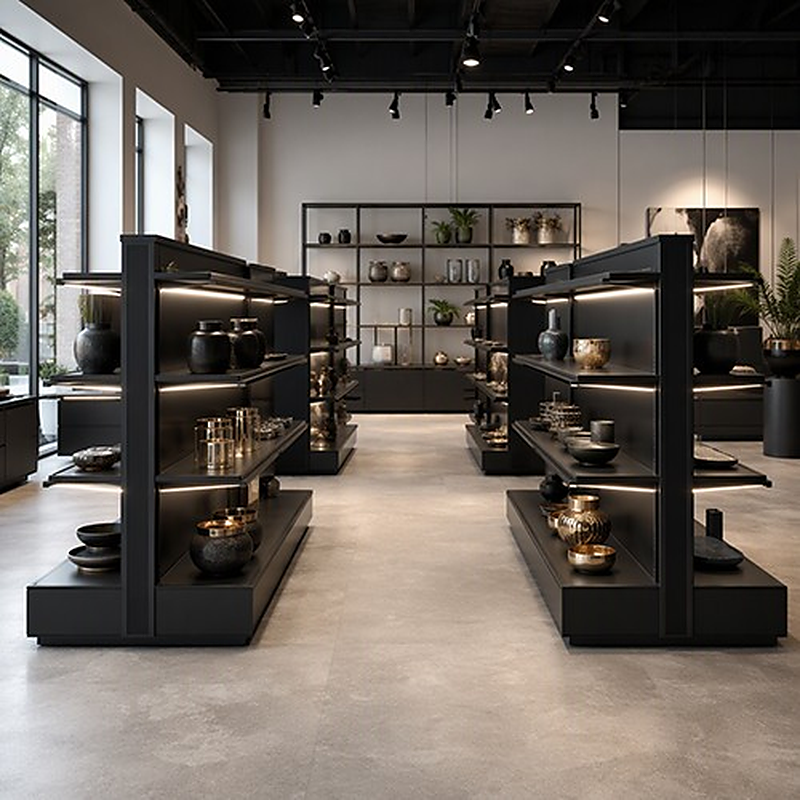
Convenience retail: short dwell time, SKU reality and the daily reset
Convenience store fixtures serve a shopper who is in and out in minutes. The layout should move people, not hold them, so the first question is where the queue forms and how a customer reaches the counter without turning an aisle into a bottleneck.
Work from category and SKU reality. Count the categories you actually sell, note the fastest movers, and check that a bay can be replenished from the back without pulling a whole shelf forward. Replenishment speed usually decides whether convenience store fixtures work in daily trading far more than any finish.
The counter and queue area deserves its own drawing. Price information should be legible from the queue, package sizes should match shelf depth, and hot or cold food equipment needs a clear boundary so food zones are not casually mixed with ambient displays. A clearance check against your busiest expected hour belongs in every convenience store fixtures plan, not just in an empty store.
Plan cleaning as a daily reset. Agree which surfaces are wiped after each shift, how spills are handled near food equipment, and which parts a staff member can reach without tools. Keep convenience store fixtures modular so a category can grow without a custom part. Ask for a planogram draft, a counter layout, a clearance drawing and a cleaning schedule in writing.
Package sizes drift over a season, so leave a little depth tolerance rather than fitting shelves to today's carton. A short queue that can borrow space from a nearby promo bay is easier to live with than a rigid counter.
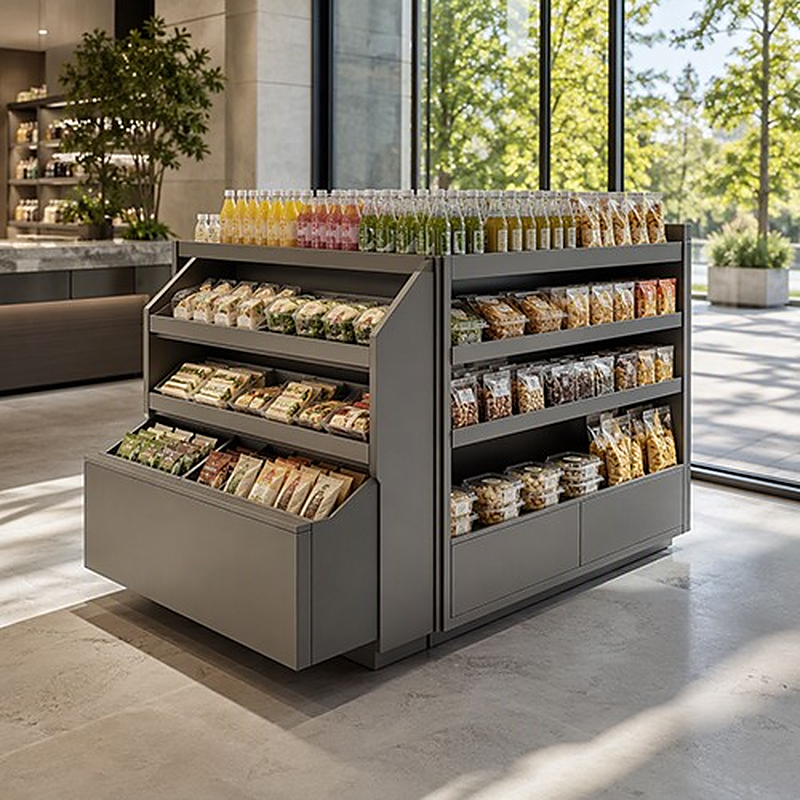
Black gondola finish, contrast and component discipline
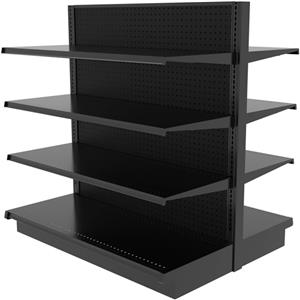
Black gondola shelving is a finish decision before it is a fixture decision. A dark surface changes visual contrast, so the sample must be judged under the lighting the store will actually use, not in a showroom box.
Check product and label visibility at real heights. On black gondola shelving, label contrast matters, and fingerprints or scuffs show sooner than on lighter finishes, so agree a cleaning routine and a touch-up approach. Never claim that black gondola shelving improves sales; contrast is a presentation choice with no guaranteed commercial effect.
Component discipline keeps a dark run tidy. Confirm that uprights, brackets, back panels and end caps come from one compatible family, ask for the shelf load each level supports, and plan end caps as part of the fixture rather than an afterthought.
Replacement and matching matter over a long life. Store spare parts, record the finish, and ask for a black gondola shelving finish sample plus a component list so a future bay matches the first one. If a claim is not in writing, treat it as unverified.
Contrast is easiest to judge in daylight and again under evening lighting, because a dark panel can read as one flat block on camera while catching glare on the floor. Keep a spare panel of the same finish for a later comparison.
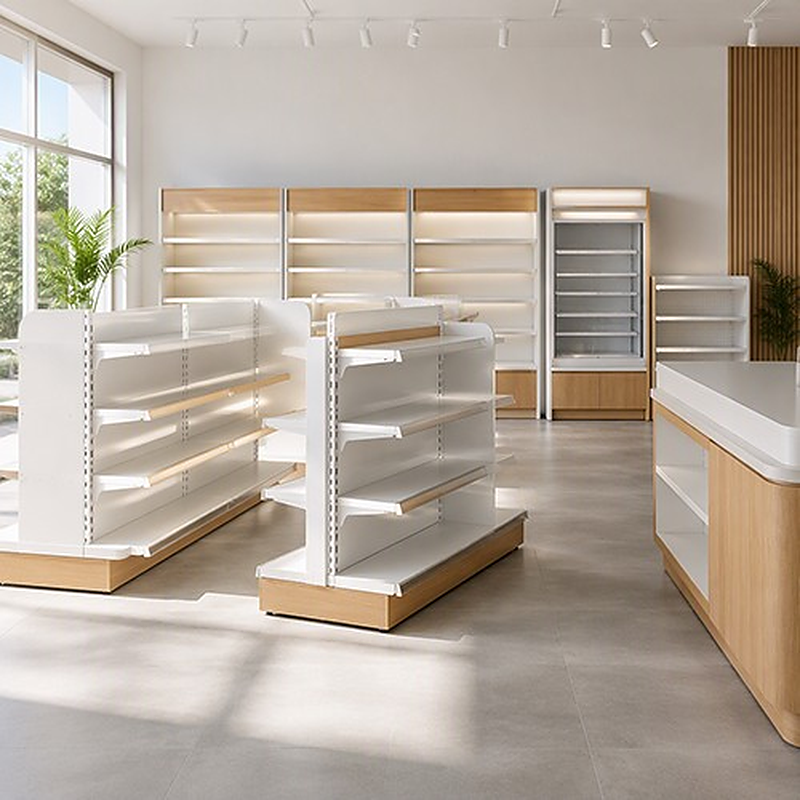
Comparison table and how to brief a project
The table below sets out the checks each project type needs and the evidence to request before an order. It is a briefing aid, not a specification.
State the project goal in one line, list the checks that matter, and attach the evidence you expect. A brief with a date, a store size and a budget band is easier to answer than a request for a price.
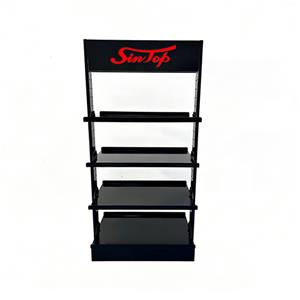
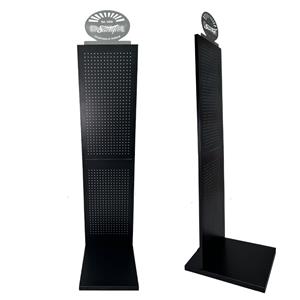
Xiamen Sintop Display Fixtures Co.,Ltd states that it was founded in 2002 and is described as a supplier offering design, prototype, production and shipment. Every project still requires drawings, a sample and agreed acceptance criteria, so treat any catalogue image as a starting point rather than a confirmed layout.
| Project type | Checks to run | Evidence to request |
|---|---|---|
| Pharmacy project | Open and staff-served zoning; shelf labels; cleanable surfaces; stock rotation; consultation and privacy pathway | Layout drawing; materials list; sample shelf; cleaning method |
| Convenience project | Category and SKU fit; replenishment; counter and queue; food-equipment boundary; price information; package sizes; aisle clearance; daily reset | Planogram draft; counter layout; clearance drawing; cleaning schedule |
| Black gondola project | Finish under store lighting; label visibility; fingerprints and cleaning; component compatibility; shelf load; end caps; replacement finish match | Finish sample; load statement; component list; spare-parts note |
Frequently asked questions (AEO)
Does the Google News RSS feed prove which fixtures are popular?
No. It is a topic-discovery source only. It does not rank products and cannot be used as evidence of demand.
Do black fixtures lift sales?
There is no such claim here. Contrast is a visual choice, and any sales effect would need store-level testing.
Can you confirm pharmacy compliance?
No. Legal, prescription, storage and controlled-substance matters belong to the responsible pharmacist and the site regulator.
What is needed to quote a project?
Drawings, a sample and acceptance criteria. Without them a quote is only an estimate.
How should the September figures be used in a brief?
As dated context and a re-check trigger, not as a fixture forecast or a demand promise for one store.
Does this page promise Google rankings or AI citations?
No. Nothing here guarantees ranking, AI citation, AI detection or originality.
Sintop Value
Sintop combines in-house metal and wood manufacturing with engineering, prototyping, production and assembly support. We help retail buyers verify fixture dimensions, materials, finishes and component compatibility before mass production.

Contact information
Website: www.sintopfixtures.com
Wechat/WhatsApp: +86 15980885084
Email: elly@xm-sintop.com
FAQ
1. What types of display racks can Sintop provide?
We offer a wide range of custom retail display racks, including metal display racks, wooden display stands, Gondola shelving, grid panels, and mixed-material solutions, tailored to your store layout and brand identity.
2. Can I order a single unit or prototype?
Yes, no minimum order is required. We can produce prototypes or single units as well as large-volume orders.
3. How long does it take to receive an order?
New items: 3–5 weeks for tooling and production.
Reorders: 2–4 weeks depending on product type.
We are flexible and strive to meet your required delivery dates.
4. Can Sintop handle OEM or ODM projects?
Yes, we specialize in OEM and ODM solutions, turning your ideas or drawings into custom, high-quality display racks.
5. How does Sintop ensure quality?
Every display rack undergoes material inspection, welding and structural checks, surface finish testing, and final assembly inspection to ensure durability, safety, and visual appeal.