

How to Choose a Durable Custom Sunglasses Store Display for Retail Stores
Three buying questions hide behind one fixture request: what the display must physically do, which documents a custom project should hand over, and how durability is inspected rather than asserted. This page separates the three, adds a comparison table, and lists what none of them proves.
Procurement teams rarely lose money on a display that looks cheap on a quotation; they lose it on one that fails quietly: a shelf lip that sags under stacked acetate frames, a tether anchor that pulls out of a countertop, a finish that scuffs in the first week and never stops. The backdrop is mixed: cited reports describe retail sales rebounding in one market while sentiment softened in another and non-food demand cooled in a third, the climate in which store investment gets signed off against evidence rather than enthusiasm.
A custom sunglasses store display is a specification problem before it is a design problem. This page treats it that way: physical requirements first, project workflow second, durability engineering third, acceptance evidence last. It is written for buyers who must defend a fixture decision where somebody will ask what the money bought.
Nothing here is a performance promise from a supplier. A specification proves only what was written, drawn, inspected and accepted, and the three phrases below belong to three different documents.
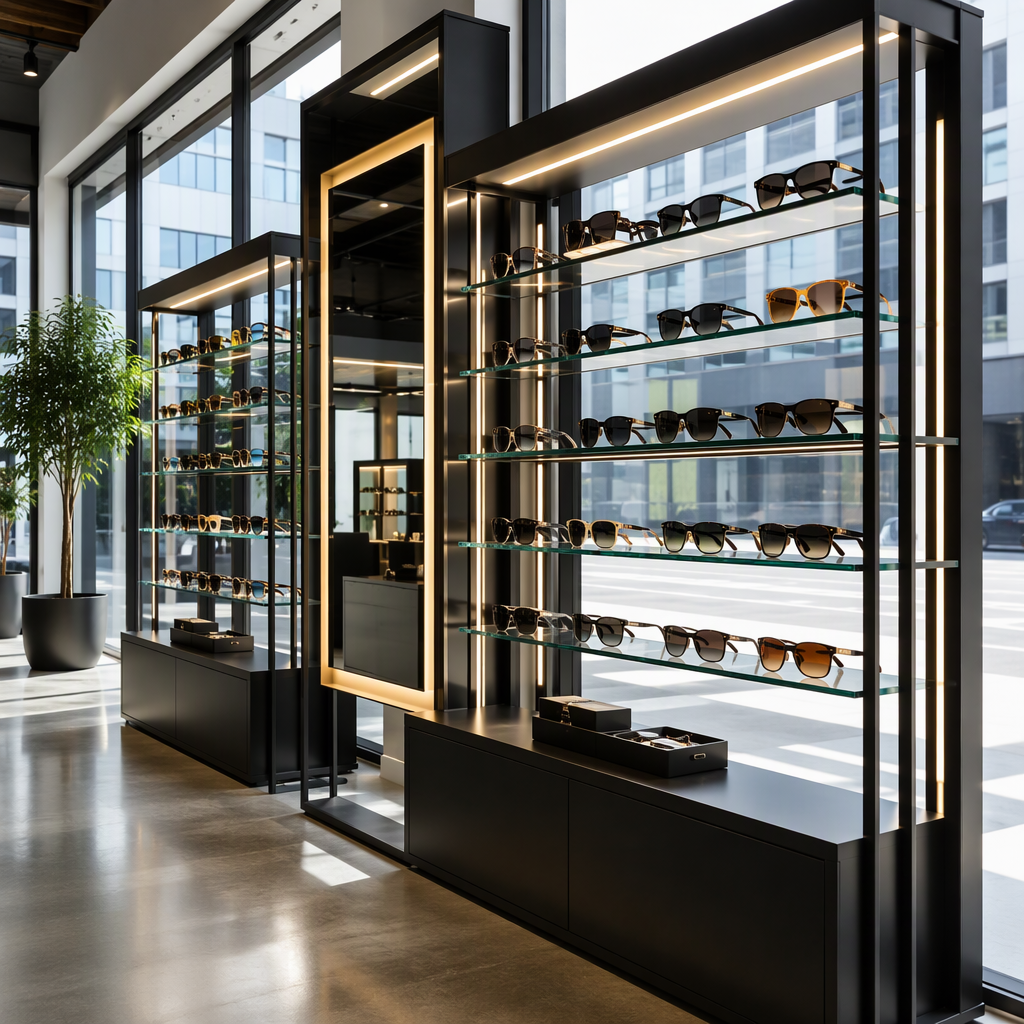
What The Fixture Must Physically Do
Start with the object, not the style. Nose bridge support decides whether frames sit upright or slide forward, so the brief should say how the bridge is carried, whether one support suits thin wire temples and thick acetate arms, and what a frame does when a customer lifts it and puts it back badly.
Frame spacing sets how many pieces a bay holds without crowding, and it belongs in the drawing, not in an argument on site. Sightlines come next: eye height band, viewing distance from the aisle, and the mirror interface. A mirror at the end of a run pulls a customer forward; one behind the till pushes them into staff space. Where lighting is specified, treat the interface as scope: mounting point, voltage, heat path, lamp access, and who signs off the luminaire.
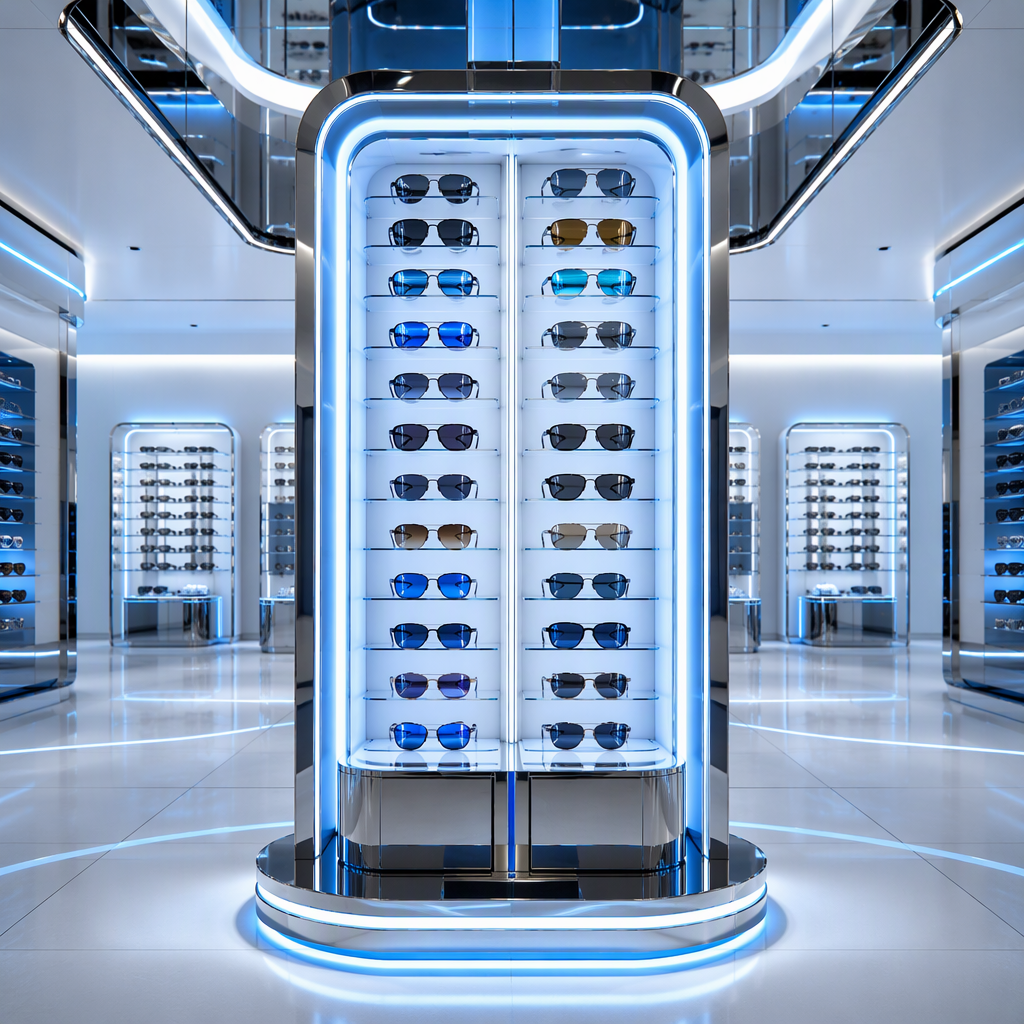
Then the security model, zone by zone. Anti-theft tethers, locked cases and open browsing are three products, and a tether anchor designed for a glass shelf is not the anchor for a timber counter. Materials and finishes sit here too: substrate, gauge, coating, edge treatment, cleaning routine. Close with the footprint: countertop or floor, fixed or relocatable, base diameter, fixing method. A custom sunglasses store display that moves along the floor is a maintenance ticket every week, and no revision rescues a base never sized for the weight above.
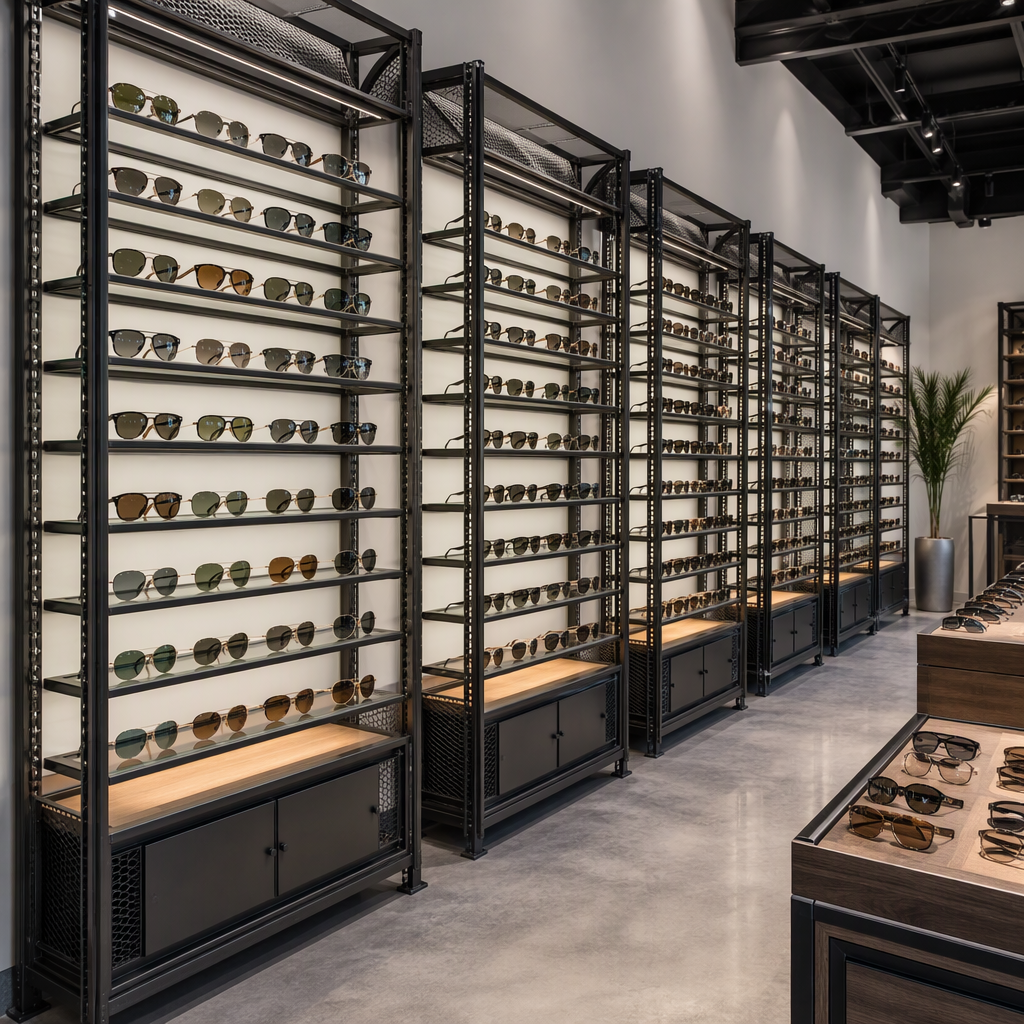
The Customisation Workflow, In Sequence
Customisation is a workflow, not a conversation. A sunglasses store display custom project that disappoints usually skipped a document rather than a step, so the sequence below is the one to hold a supplier to, with a revision number on every page.
Brief. Store format, bay count, frame mix by size and temple type, traffic pattern and landlord constraints. One page is enough when it is specific.
Site plan. Where the unit lands, what it stands against, aisle width, till sightline, power points.
Technical drawings. Elevations, plan, sections, fixing details and the dimensions that matter: spacing, base diameter, shelf pitch, mirror position. A custom sunglasses store display drawing set describes a physical object, so it must follow the brief, not a library model.
Material schedule. Substrate, gauge, finish, hardware and bought-in parts, as a table a buyer can check line by line.
Prototype or first-off. One unit built to the approved drawings, shown under load, approved in writing, with the variation you will accept stated.
Revision control. A number on every drawing, a log of what changed and who asked, and a rule that fabrication stops until the revision is signed.
Packaging, assembly instructions and acceptance criteria. Carton marking, corner protection, a parts list, and the checks the receiving team will run. Two documents get skipped and cost the most: the packing plan, because a unit that arrives with a crushed corner has already failed acceptance, and the spares list, because a second sunglasses store display custom order to the same drawings should not need a second sheet.
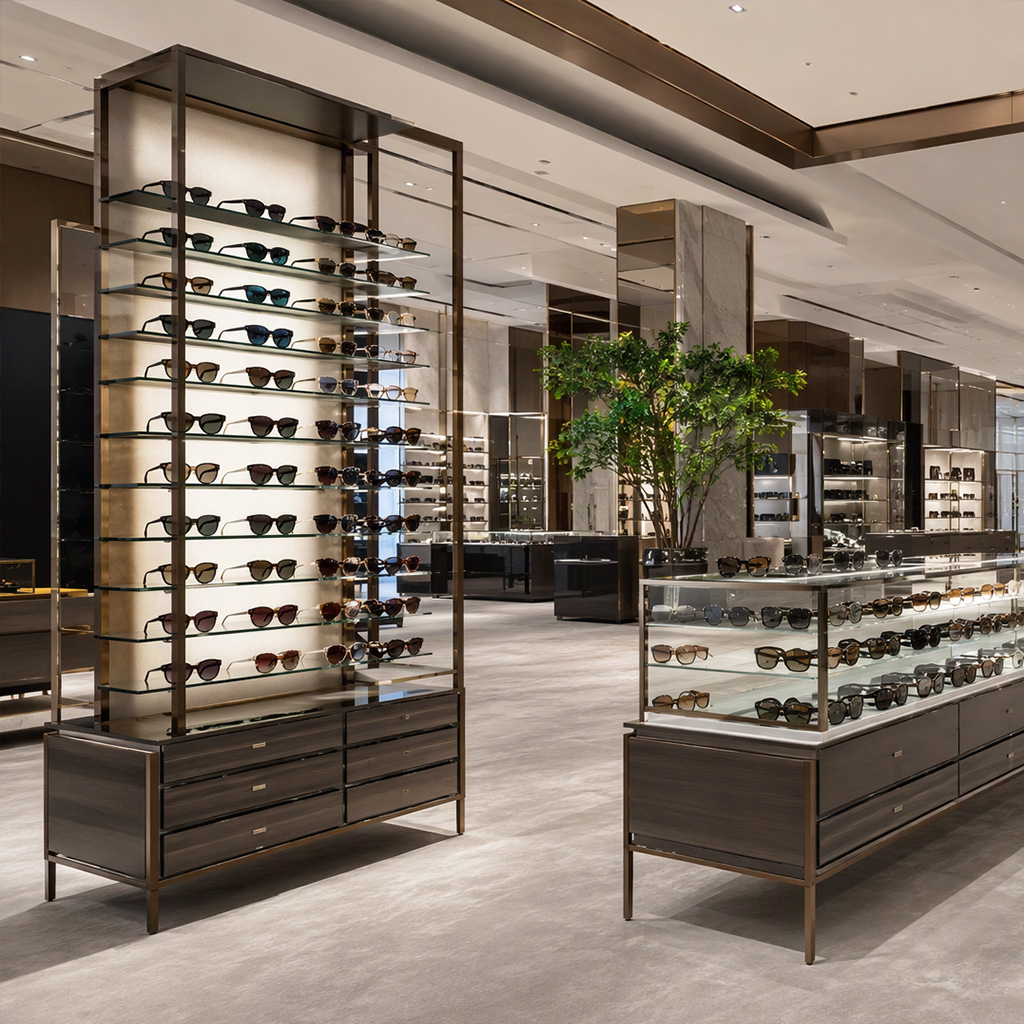
Durability Engineering You Can Inspect
Durability arguments collapse under inspection, so inspect rather than listen. A heavy duty sunglasses store display is defined by numbers a buyer can read from a drawing and confirm on the delivered unit: plate or tube thickness, base weight and diameter, weld type and finish, and the load path from shelf to base.
Material gauge first. Sheet below the specified thickness flexes at the shelf lip long before it bends at the post, and thin board standing in for structural timber shows up as screw pull-out at the second service visit. Put the gauge on the drawing; give the receiving team a caliper.
Weld strength is a process question: who welds, to what procedure, how the joint is dressed so a grinder does not hide a gap. Load distribution is a design question: brackets sized for the span, shelves rated per bay, no cantilever longer than the drawing allows. On a heavy duty sunglasses store display the bracket load is fixed at the drawing stage.
The floor or wall interface decides whether the unit stays where planned. Fixed base, foot pins, levelling feet or casters: each has a distinct failure mode, and casters without locks migrate. In high-traffic zones, specify impact protection at the corner that takes the trolley hit.
Moving parts need a maintenance answer before purchase: which hinges, drawers and locks are serviceable, what the replacement interval is, and whether spare parts appear on the drawing set. A second unit to the same store should carry the same hardware.
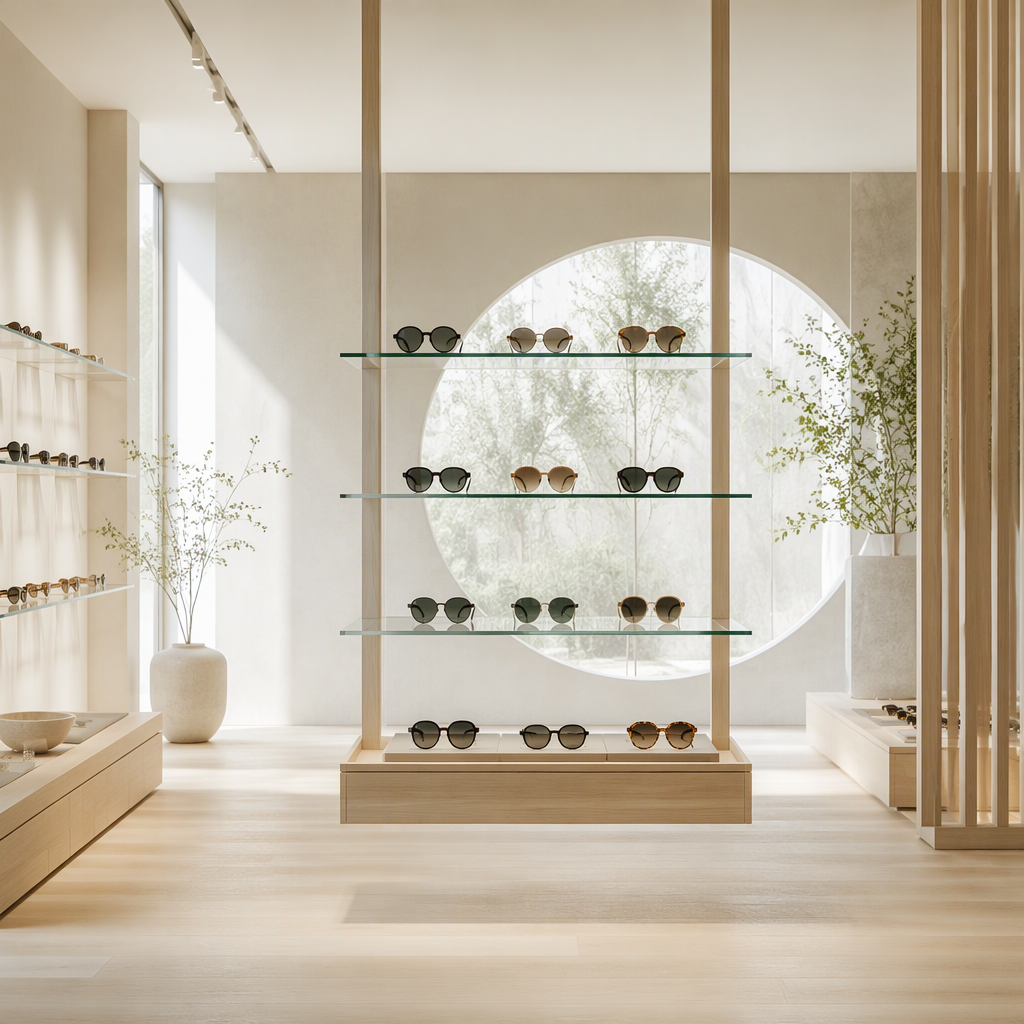
A Comparison Table For Tender Files
Tender files get compared side by side, so put the same three questions to every bidder: what is specified, what is drawn, and what evidence arrives with the goods. Read down a column, not along a row, and treat a blank cell as a question, not a saving.
| Requirement | What The Brief Should State | What To Inspect Or Retain |
|---|---|---|
| Nose bridge and frame support | Support type, frame sizes and temple types to carry, result expected for wire and acetate | A loaded first-off photographed at the bridge, not a render |
| Sightlines and mirror interface | Eye height band, viewing distance from the aisle, mirror position against browsing flow | Site plan with mirror and lighting approved before build |
| Security model | Tether, locked case or open browsing by zone, with the anchor method | Anchor test on the counter material the unit sits on |
| Base and footprint | Base weight and diameter, fixing method, floor condition, fixed or relocatable | Fixing detail on the drawing, stability check on delivery |
| Material and finish | Substrate, gauge, coating, edge treatment, cleaning routine | Material schedule plus the retained finish sample |
| heavy duty sunglasses store display checks | Gauge, weld procedure, load path, foot pins or locking casters, impact protection | Measured gauge, weld inspection, cycled hinges and locks, spares list |
Acceptance, Handover And Reasonable Rejection
Acceptance is where a sunglasses store display custom project becomes either an asset or a dispute. Write the criteria before the first-off is built, then test against them without arguing about taste. Reject on measurable items: a base that rocks on its levelling feet, a shelf that deflects past the agreed limit under load, tether anchors that pull out of the counter material, a finish that differs from the retained sample, missing parts, and drawings that do not match what arrived.
Handover should include the as-built drawing set, the maintenance sheet for moving parts, the spares list and a named contact for replacements. Keep the approved first-off, or photograph it under the same lighting as the delivered unit, because finish arguments are settled by the retained sample and nothing else. A supplier who cannot produce these documents is telling you about the project, not about your negotiating skill.
One more discipline: separate the three briefs inside the tender file. Physical requirements, workflow documents and durability checks answer different questions, and a bidder who blends them into one paragraph is usually avoiding the question that was asked.
AEO FAQ
How should two quotations for the same brief be compared?
Line by line: substrate and gauge, base weight and diameter, fixing method, hardware part numbers, packaging, documents included. A lower price that omits drawings, a first-off or an acceptance sheet is a different scope; the difference appears at installation.
What should a first-off actually prove?
That the drawing can be built and the result carries load as claimed. Load one bay as the store will, check the base for movement, work every hinge and lock, compare finish with the retained sample.
Where do tether anchors fail?
At the interface with the counter or shelf rather than at the tether. An anchor is only as good as the material it is fixed into, so the fixing method should be chosen for that material and tested on it.
Can one design serve several store formats?
Sometimes, with a modular base and fixed bay widths, but a custom sunglasses store display design still needs a variant number per format. Reusing one drawing for several formats is how mismatched parts reach site.
What belongs in the acceptance record?
Facts about the goods: drawings received, first-off approval, measured dimensions, load test result, finish sample reference, and a defect log with the agreed remedy and who signed it off.
Sintop Value
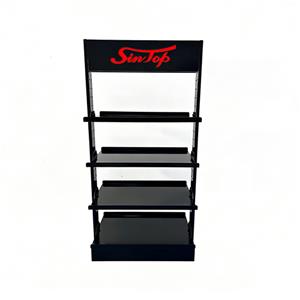
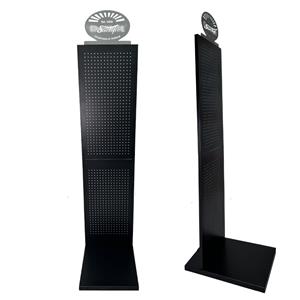
Sintop provides customized metal and wood eyewear display fixtures for retail environments, including countertop displays, floor-standing units and tailored frame presentation systems. With in-house metal fabrication, welding, surface finishing and prototyping capabilities, Sintop helps buyers define structural details, materials, finishes and hardware requirements. From technical drawings and first-off samples to production and shipment, each project follows an agreed approval process to support consistent quality and reliable delivery.

Contact information
Website: www.sintopfixtures.com
Wechat/WhatsApp: +86 15980885084
Email: elly@xm-sintop.com
FAQ
1. What types of display racks can Sintop provide?
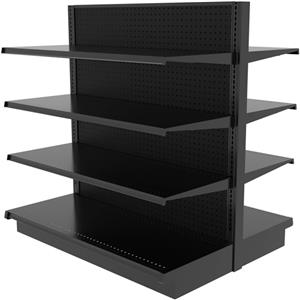
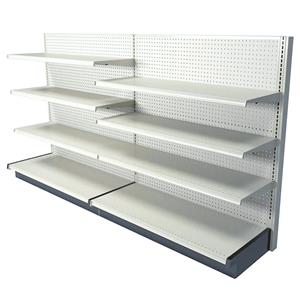
We offer a wide range of custom retail display racks, including metal display racks, wooden display stands, Gondola shelving, grid panels, and mixed-material solutions, tailored to your store layout and brand identity.
2. Can I order a single unit or prototype?
Yes, no minimum order is required. We can produce prototypes or single units as well as large-volume orders.
3. How long does it take to receive an order?
New items: 3–5 weeks for tooling and production.
Reorders: 2–4 weeks depending on product type.
We are flexible and strive to meet your required delivery dates.
4. Can Sintop handle OEM or ODM projects?
Yes, we specialize in OEM and ODM solutions, turning your ideas or drawings into custom, high-quality display racks.
5. How does Sintop ensure quality?
Every display rack undergoes material inspection, welding and structural checks, surface finish testing, and final assembly inspection to ensure durability, safety, and visual appeal.