

How to Choose Wood Retail Shelving and Metal Wood Gondolas
A guarded brief for retail buyers: what public sources can and cannot show, and how to test a shelving proposal with samples, loads and written acceptance criteria instead of repeating a keyword.
Retail buyers seldom approve a fixture because a headline looked strong. Broad spending and confidence figures describe national conditions, not the bay in one store, so a proposal has to earn approval through a testable operating brief: named materials, measured loads, a physical sample and written acceptance criteria, rather than a phrase repeated for its own sake.
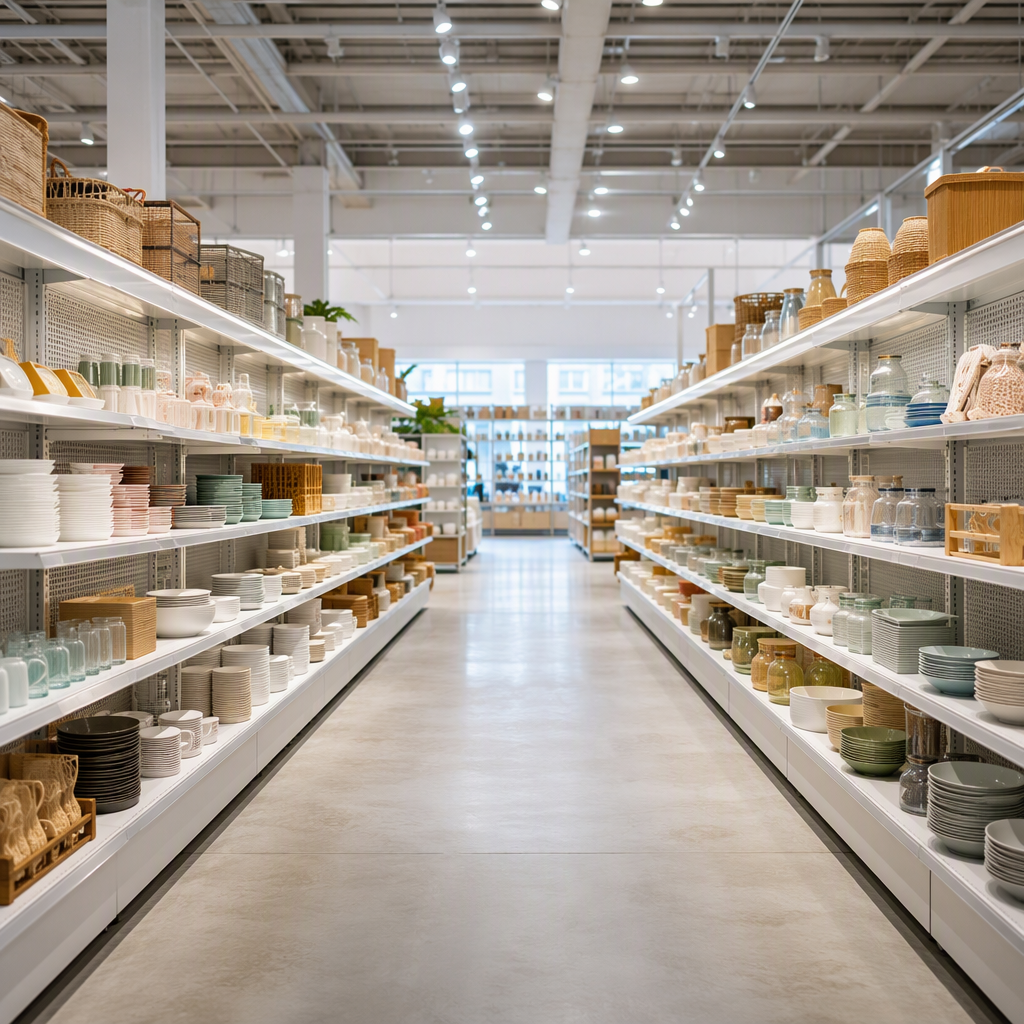
Reading Retail Signals: Discovery, Spending and Mood
A public news feed is used here only to see which retail subjects editors choose to publish. Its leading stories were not specific to store fixtures or shelving, so the feed establishes nothing about popularity, demand or placement; it is treated as topic discovery alone and never as a ranking or a demand forecast.
Two cited releases matter more as background. The cited retail-sales report describes national spending that rebounded over its own reporting period, higher than the prior reading and higher than a year earlier, not adjusted for inflation. The cited consumer-sentiment report describes a survey that weakened over its period, with a lower index reading and a rising one-year inflation expectation. Each is a national picture, and neither is about a single store, aisle or fixture order.
Overseas numbers add contrast, not proof. The cited retail-consortium report describes total retail sales growing year on year in one market, with food positive and non-food negative. The cited weather observation records an extreme outdoor temperature at one place, and it supports no conclusion about fixtures, coatings or store conditions. Each source is cited for its own narrow scope.
The facts and the judgement point in different directions. Measured spending improved at the same time as a sentiment survey fell, so the two do not describe one simple story. The judgement here, and not the sources', is that a cautious shopper makes a retailer more careful about what it signs off. No release cited here proves fixture demand, order volume or a sales effect from any shelving choice, and none should be read that way.
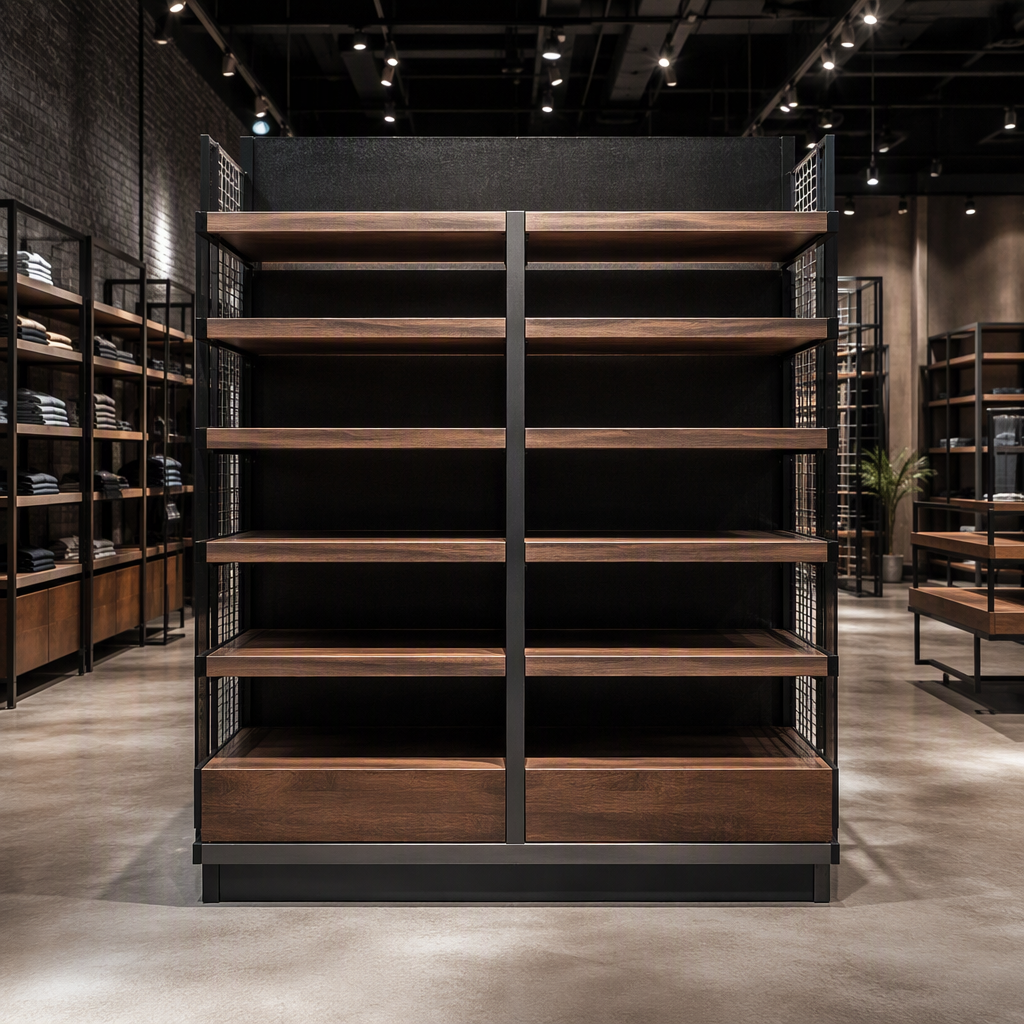
Material Fact Against Visible Finish Claims
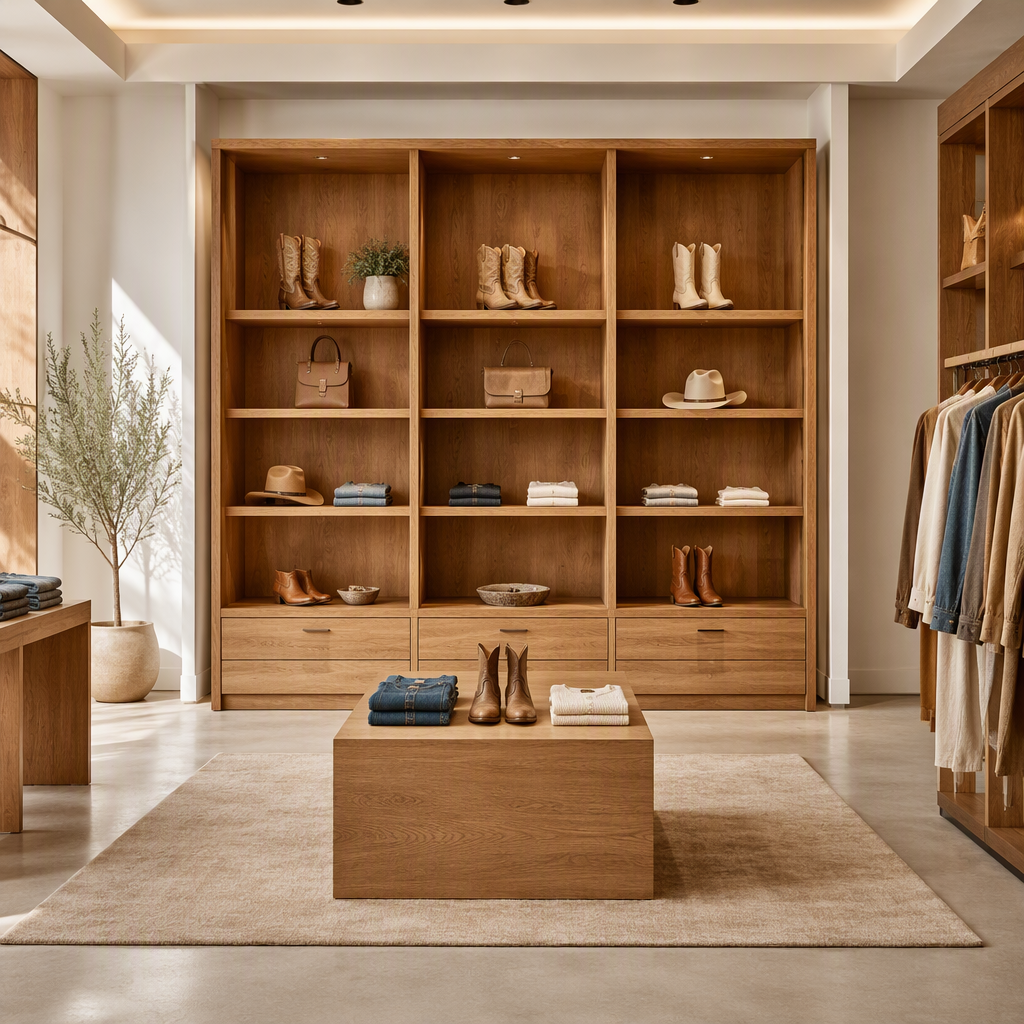
A buyer asking about wood retail shelving is separating a structural fact from a surface story. A unit can be called solid wood when the visible face is a veneer or a decorative panel over another core. Both can be legitimate; the risk is approving one and receiving the other. Ask for the substrate, the visible face and the edge treatment as separate line items on a drawing.
Finish belongs under the store's own lighting. A sample of wood retail shelving should be checked at the height the shelf will sit, because accent light and ceiling light make one tone read two ways. Ask what a cloth and a mild neutral cleaner do to the face, then record the store conditions the brief must cover. No claim should be accepted that wood is heatproof or weatherproof, because a material name does not guarantee those properties.
Load support and small details decide daily use. Confirm the load each shelf carries, how it reaches the uprights, and whether the shelf edge holds a price rail or label holder without bending. Shelf edge and label detail matter most on wood retail shelving that is re-labelled often, because repeated clipping loosens a soft edge.
Plan for matching later. Record the finish code, the panel build and the edge profile so a bay added in a later phase matches the first delivery. Replacement finish matching is simplest when wood retail shelving is specified as a small family of panels rather than a one-off, with a spare face sample kept on file.
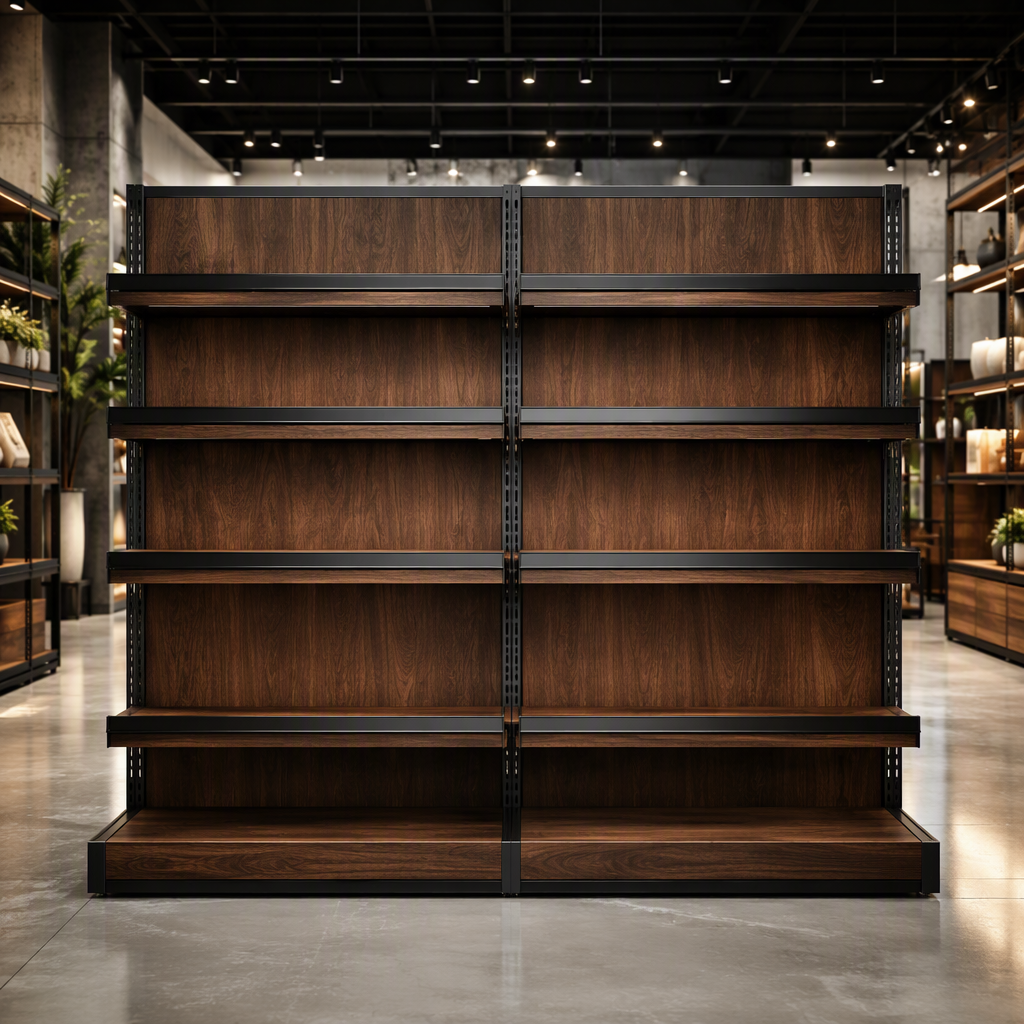
Mixed-Material Interfaces, Joins and Revision Control
The second intent is a mixed-material question. A metal wood gondola pairs a metal frame with wood or wood-faced parts, and the boundary between them matters. Ask how a wood panel meets the metal frame, whether the shelf support is carried by the frame or the panel, and where one finish stops and the other begins. A clean interface is a drawing detail.
Joins need to be named. Fasteners, clips, brackets and slot systems behave differently on a metal wood gondola, and each has a service life. Ask which joins are adjustable, which are fixed and which can be re-tightened on site. Assembly and levelling belong here too, because an uneven floor shows at the frame first, so state how the run is levelled and what tolerance is accepted. A wood-and-metal build is not automatically more durable than either material alone.
Load distribution between two materials is the risk to think through. On a metal wood gondola, a heavy load can pass through the panel rather than the frame unless supports are positioned to take it, so ask for the load per shelf and per support point, then check how the total reaches the floor. Carton and transport protection deserve a line: agree how panels are packed, corner-protected and separated from metal parts. Revision-controlled drawings should carry a number, so the approved and produced versions can be compared.
Keep one file for the project: the approved metal wood gondola drawing, the sample sign-off, the packing note and the spare-part list. When a supplier proposes a change, ask for a new drawing number rather than a description, and hold the original as the baseline.
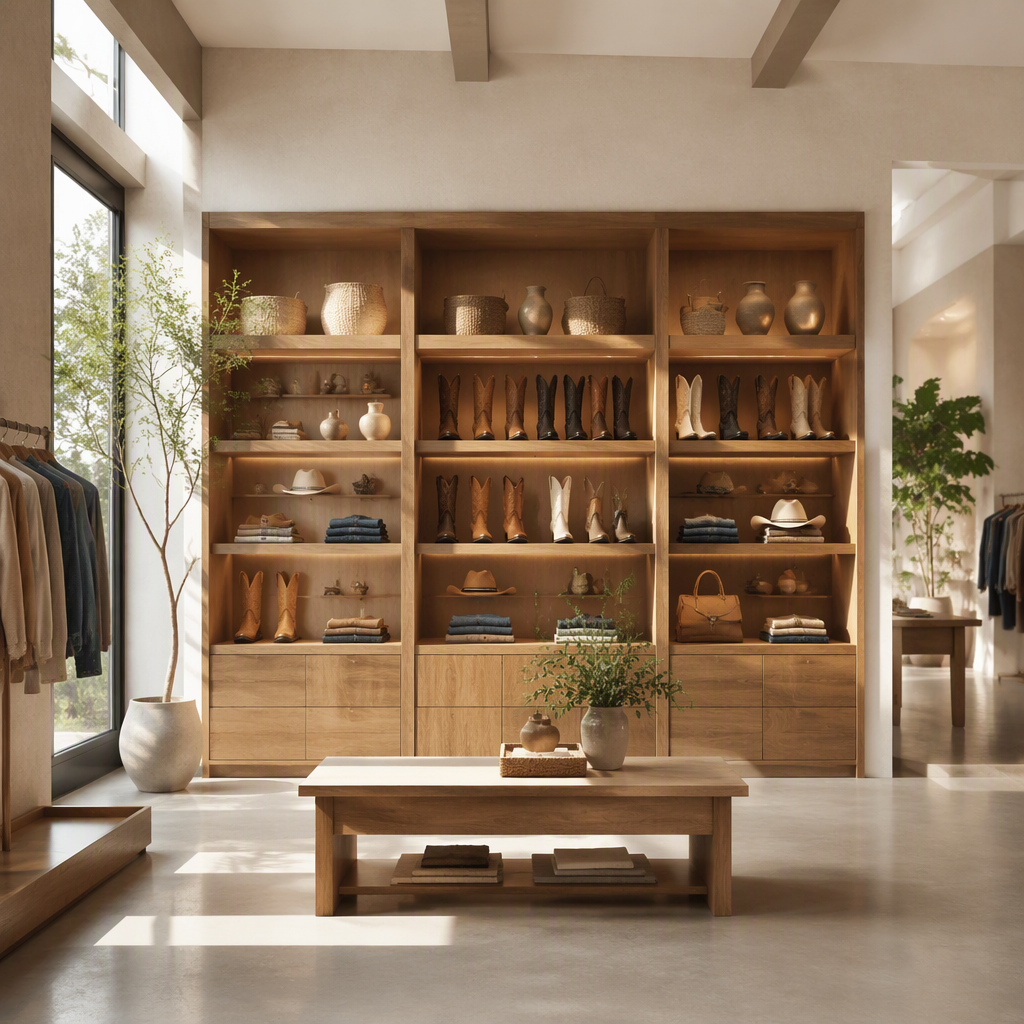
Layout, Loading and the Changeover Path
The third intent is the whole run. Retail gondola shelving is best planned from the aisle outward, so measure the main walkway at its narrowest point, settle bay depth and height, and decide where customers and trolleys pass before any unit is chosen. A layout that reads well on a plan can still fail at a busy hour, so state the aisle clearance the store will keep.
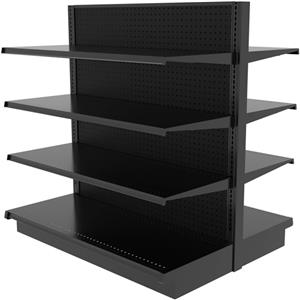
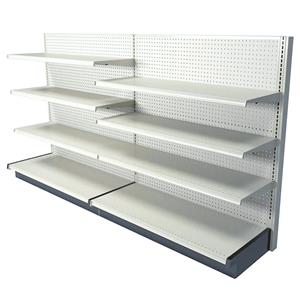
Configuration follows the plan. Single-sided units back onto a wall, while double-sided units form an island run with two trading faces, which changes footfall and replenishment. On retail gondola shelving, end bays carry the first impression and often the highest-value stock, so they deserve an explicit decision. Price rails and labels should be specified with the shelf, because a rail added later can sit at the wrong height.
SKU and replenishment reality shapes the build. Count categories and fastest movers, check whether a shelf can be refilled from the back without clearing the front, and set shelf loading from the heaviest product.
For retail gondola shelving, spare parts decide how long a store stays tidy, since brackets, rails and panels reordered individually keep a run complete. Plan the changeover path too, meaning how a section is emptied, moved and rebuilt, and state installation access, working hours and who levels the run.
The aim is a brief that can be tested, not a claim repeated. A retail gondola shelving proposal earns approval when it names the aisle width, the load per shelf, the label system, the end-bay plan, the changeover method and the spare parts, and when each can be measured on site against the drawing.
Comparison Table, AEO FAQ and a Testable Brief
The table below keeps the three intents apart and lists the evidence to request before an order. It is a briefing aid, not a specification, and it does not replace a drawing, a sample or agreed acceptance criteria.
Comparison Table: Intent, What to Check, Evidence to Request
| Intent | What to check | Evidence to request |
|---|---|---|
| Material and finish | Substrate against visible face, finish under store lighting, cleaning, store conditions, load per shelf, shelf edge and label detail, replacement finish match | Panel build drawing, finish sample, cleaning guidance, load statement, spare face sample |
| Mixed-material assembly | Wood-to-frame interface, shelf supports, joins, assembly and levelling, load per support point, finish boundary, carton and transport protection, revision-controlled drawings | Interface drawing, join schedule, load data per support, packing note, numbered revision |
| Aisle-level layout | Aisle width, single and double sided mix, SKU and replenishment, shelf loading, price rails and labels, aisle clearance, end bays, changeover path, installation, spare parts | Layout drawing, load per shelf, label schedule, changeover method, spare-part list |
A checklist follows from the table: store format and measurements, the material build behind any visible face, the load per shelf and support, assembly and levelling, delivery and packing, the label system, the changeover method and the spare parts.
Frequently Asked Questions (AEO)
Do broad retail figures show that shelving demand is rising?
No. The cited releases describe national spending and consumer mood, and cannot show fixture demand, order volume or a sales effect from any shelving choice.
Does a public news feed rank products?
No. It is a topic-discovery source only, with no popularity ranking and no search volume, and its leading stories were not shelving-specific.
Can wood be guaranteed heatproof or weatherproof?
No such claim is made here. Finish and material behaviour should be checked against the store's own conditions with a sample, and any guarantee belongs in the agreement.
Does a metal-and-wood build last longer?
Not automatically. Durability depends on the interface, the joins, the load path and the maintenance routine, so it should be verified on a drawing and a sample rather than assumed.
Does this page promise rankings or AI citations?
No. Nothing here guarantees a search ranking, an AI citation, AI detection or originality.
Sintop Value
Sintop combines metal and wood manufacturing with design, prototyping, and production support for customized retail fixtures. We help buyers assess material specifications, mixed-material interfaces, shelf loading, layout requirements, and changeover needs before production begins.

Contact information
Website: www.sintopfixtures.com
Wechat/WhatsApp: +86 15980885084
Email: elly@xm-sintop.com
FAQ
1. What types of display racks can Sintop provide?
We offer a wide range of custom retail display racks, including metal display racks, wooden display stands, Gondola shelving, grid panels, and mixed-material solutions, tailored to your store layout and brand identity.
2. Can I order a single unit or prototype?
Yes, no minimum order is required. We can produce prototypes or single units as well as large-volume orders.
3. How long does it take to receive an order?
New items: 3–5 weeks for tooling and production.
Reorders: 2–4 weeks depending on product type.
We are flexible and strive to meet your required delivery dates.
4. Can Sintop handle OEM or ODM projects?
Yes, we specialize in OEM and ODM solutions, turning your ideas or drawings into custom, high-quality display racks.
5. How does Sintop ensure quality?
Every display rack undergoes material inspection, welding and structural checks, surface finish testing, and final assembly inspection to ensure durability, safety, and visual appeal.